Introduction
Atkinson (2002) stresses that art should not be seen as a mere add-on but as a fundamental resource for exploring identities and practices in the educational context. Despite obstacles and low budgets, educators across disciplines leverage art and play to enhance students’ learning experiences, fostering creativity and promoting collaborative work. Sawyer (2014) describes comprehensively how group dynamics influence creative processes, especially in arts contexts such as music and theatre. He highlights that group creativity arises from dynamic interactions and communication among members.
In this sense, a standard way of integrating art and theatre is through “applied theatre”, where the aesthetic elements of the creative process do not overshadow the ethical considerations of theatrical creation, and the tools of the stage foster learning in classrooms. “Drama-in-Education” is a stand-alone subject that promotes holistic, issue-based education through theatre, placing the process over the final product (Flintoff, 2005; Sanoubari et al., 2023). Research has revealed that students’ participation in arts in classroom awakens their interest in learning, strengthens their self-esteem, and improves their ability to cope with challenging situations. “During the increasingly deeper learning process (theatre) transforms the ‘spectator’ into a thinking-playing individual immersed in a group” (Boal, 1979/2000, p. 134). Role play turns the classroom into a stage and is widely used in language and social science teaching. Socially, theatre nurtures cohesion, memory retention, and community building. In universities, educational theatre takes the form of mock appointments, trials, and consultations, where actors assist future doctors, lawyers, and psychologists in their training. Educational theatre lends the classroom to play, and this “is a natural and collective configuration that provides the necessary participation and personal freedom to experiment” (Spolin, 1963, p. 20).
Robots have been used in theatrical plays as characters since the 20th century, such as in Karel Čapek’s R.U.R., where actors played artificial humans (called robots) created to help relieve people’s workload (Horáková, 2011). With advances in robotics, robot actors have intervened in plays as themselves and human or animal characters (Eckersall et al., 2017; Sone, 2017). Currently, there are plays robots solely perform or that involve robot characters alongside human actors on the same stage. For example, in 2010, the Copernicus Science Center in Warsaw (Poland) created the first robotic theatre performed exclusively by humanoid robotic actors (Sovhyra, 2021). However, robotic theatre has focused primarily on entertainment (Eckersall et al., 2017; Nijholt, 2018; Sovhyra, 2021).
Robotic theatre has also emerged as an innovative approach to promote STEAM education in various age groups, from elementary school children to university students (Bravo & Páez, 2023; Dong et al., 2024; Ko et al., 2020). These programs usually involve students writing scripts, programming robots, and staging live performances (Barnes et al., 2020; Mitchell et al., 2024; Szecsei, 2019). Integrating robots into theatre productions has shown promise for engaging underrepresented students in STEM fields (Szecsei, 2019) and improving children’s interest in STEAM subjects (Dong et al., 2023). Research has demonstrated that robotic theatre can effectively teach robotics, computer science, and arts while maintaining student engagement (Barnes et al., 2017, 2020). In addition, these programs provide opportunities to explore AI and robot ethics with young students (Dong et al., 2024). Some work has focused on improving the emotional expressiveness of robots to create more believable performances (Celis Buitrago et al., 2020). During the COVID-19 pandemic, robot theatre was also used as a distance learning tool, showing high acceptance rates among educators and students (Tobar et al., 2021).
Most of the articles identified in the literature center on theatrical productions with robots, in which students take charge of programming them to dramatize the play (Bravo & Páez, 2023; Dong et al., 2023; Mitchell et al., 2024; Sanoubari et al., 2023). In these cases, student learning occurs —principally— while creating the work, with the artistic quality of the final production being a secondary concern. However, there is a notable lack of research on using professional robotic theatre as an educational tool. In this approach, learning ensues during the performance, either through interactive methods such as forum theatre or via the active participation of the audience in shaping the development of the play. Several challenges can be attributed to this research gap, including limited programming and engineering skills, high robot costs, and limited theatre portability, which makes it difficult for teachers and students to implement high-quality artistic robotic theatre plays in educational contexts (Bravo & Páez, 2023; Páez Rodríguez, 2019). In addition, most educational robotic theatres are found primarily in science and technology centers and museums, with many still in their early stages (Sovhyra, 2021).
In the model where students act as active or passive audiences of robotic theatre performances, implementing forum theatre activities can enhance learning. These allow students to participate interactively, reflecting on the topics presented, exploring different perspectives, and proposing solutions to the conflicts addressed. Moreover, forum theatre is highly adaptable to various fields, such as healthcare, social sciences, and moral education (Thamdrup et al., 2024). Its format facilitates reflection in action and reflection on action as students participate in discussions about the plays presented. These forum sessions promote community sense by encouraging participants to share viewpoints and support each other in their learning experiences (Thambu et al., 2020); besides, it provides a safe environment to explore sensitive or taboo subjects without the need for students participants to reveal their identities, making it especially valuable in educational contexts where open dialogue about challenging issues is an essential element for personal and collective growth (Hakkarainen & Vapalahti, 2011).
The aim of this paper lies in contributing to research on educational robotics theatre by developing and exploring a methodology for the creation, staging, and performance of high-quality ERTP with artistic value, highlighting professional robotic performances in which students are not involved in the creation of the storyline or programming of the robots. With this proposed methodology, the learning process is designed to occur during the play performance, where students can be actively implicated by intervening in the narrative development or participating in activities such as forum theatre.
Thus, a team of engineers, artists, and educators was conformed to create and perform an ERTP. This article describes the methodology used to develop it and shares the experiences and lessons learned during the process. It also discusses the technical and pedagogical challenges when creating this type of theatre.
Method
Study design
This article reflects the collaboration between an interdisciplinary team of art, engineering, and education experts, whose goal involved designing and implementing an ERTP for children aged 8 to 12. The cross-curricular research group consisted of six professionals: two in educational technology, two in robotics and engineering, and two artists with expertise in scriptwriting and theatre. The roles and responsibilities of each member are explained in detail in the systematization of the results.
An SE method was applied to summarize the ERTP methodology, the lessons learned, and the challenges encountered during the creation. SE involves a collaborative and inclusive process that fosters action-based learning through innovative educational practices (Guimarães et al., 2017). According to Jara-Holliday (2018), SE implicates understanding how elements and factors interact to bring about change in educational settings. It is primarily a reflective exercise in which participants take charge of the entire process by identifying necessary steps, guiding questions and an action plan.
This paper focuses on an ERTP methodology to mediate learning processes in the classroom, and it is applicable in forum theatre contexts, specifically through the QuycaBot: Scriptwriting for Educational Robotic Theatre Plays project. In previous works, teachers or students designed plays with an educational purpose; thus, the resulting plays lacked artistic quality and did not facilitate their reuse (Bravo & Páez, 2023). To solve this situation, a new approach was adopted, developing a methodology based on professional dramatizations to create better-quality ERTPs.
Data collection and procedure
The SE consisted of four structured phases (figure 1) designed to facilitate reflection on the experiences gained, critically analyze them, and draw meaningful conclusions for future applications.
-
Start point and research questions: Systematization began identifying the principal research questions that guided learning and reflection. In this project, two questions were formulated: “What were the key elements of the methodological design of ERTP for children?”, and “What were the methodological
challenges of this proposed model?”.
-
Data collection: The next phase
involved collecting data and narratives from the project participants, six
members of an interdisciplinary team from three disciplines: educational
technology, engineering and robotics, and performing arts. Team members held weekly working meetings throughout the project, which lasted approximately twelve
months. Each project phase, including four ERTP scripts and the preparation and staging of the selected play Red and Blue, was documented through meeting minutes. In these
rendezvous, the group maintained a reflective attitude on the methodological decisions and actions undertaken and the learning outcomes achieved during the process.
-
Critical reflection: This phase focused on the exhaustive analysis of the experiences collected. It
involved examining why specific results occurred and identifying the factors,
as well as the challenges influencing these results. In addition, the interdisciplinary team was encouraged to participate in collective discussions to reflect on their experiences, enriching the critical
analysis.
-
Identification of results: Finally, knowledge gained during the critical reflection was summarized. To this end, the principal lessons learned were highlighted, the best practices were identified, and areas for improvement
that emerged throughout were pointed out.
 Figure 1
SE methodology
Figure 1
SE methodology
Source: own elaboration.
Data analysis
To reconstruct the experience, a chronological matrix of each stage was used to obtain a detailed and complete panorama of the process. Subsequently, the research team conducted a descriptive, critical, and interpretive analysis, identifying the objective and subjective factors that influenced the process, how they interacted, and why they developed in that way (Jara-Holliday, 2018).
To reconstruct the experience, a chronological matrix of each stage was used to obtain a detailed and complete panorama of the process. Subsequently, the research team conducted a descriptive, critical, and interpretive analysis, identifying the objective and subjective factors that influenced
the process, how they interacted, and why they developed in that way
(Jara-Holliday, 2018).
Results
This section includes the results of the project based on SE. First, it provides a detailed description of creating four scripts for ERTP and the staging of the Red and Blue play. Second, it offers a reflective analysis of the experience and the characteristics of the methodology employed. Finally, it presents the lessons learned from the process and proposes a scheme for ERTP.
Description of the experience
-Selection of teamwork and tasks. The team was strategically divided into three groups based on their areas of expertise. The first focused on the educational aspects of the storyline to ensure that the learning objectives were met. The second concentrated on the technical components, including scriptwriting and robotic actor adaptation. The third prioritized the dramatic value of the script and staging, adapting the play for robotic performance.
To improve the staging process, the team collaborated with a puppet theatre artist who advised them on effectively presenting the robots in a theatrical context. As the project progressed toward staging, additional members were recruited to fulfill specific needs. This expanded team included an artistic director, a musician, a lighting designer, and two electronic engineers, who were responsible for designing and programming the robot actors, creating the set design, and developing the lighting and music. Artistic and technical experts coordinated their contributions, ensuring a seamless integration of the robotic and theatrical elements in the final production.
-Planning of the theatrical work. Four different scripts were developed in the project, each with a different level of complexity in the staging. This variability was reflected in aspects such as the number of characters, the locations, the expressive features of the robot actors, and the level of interactivity with the audience, among other elements. The diversity aimed at exploring different creative and technical approaches to the creation of robotic plays. However, for the final implementation, only one of the scripts was selected for execution in staging.
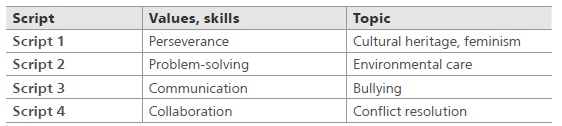
The learning objective of the ERTP was to foster the development of social and emotional skills in the students. To achieve this, a selection process of the values and skills to be fostered was carried out. As a result, four key values were identified as showing the most adequate educational impact and relevance for the project’s beneficiaries: perseverance, problem-solving, communication, and collaboration.
Through these values, the central themes of the plays were defined and specifically designed to facilitate the development and strengthen these skills in the students. In this case, four scripts were created, each focused on a particular value or skill (table 1). For each script, an educational message was developed, addressing the selected topic, presenting potential solutions, and effectively integrating the corresponding value or skill to be promoted within the narrative.
Table 1
Selection of topics, values, and skills
Source: own elaboration.
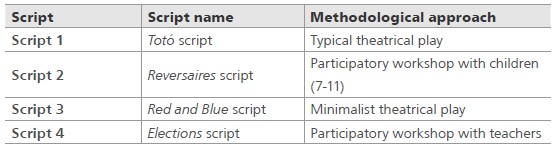
To develop these scripts, four approaches were explored based on Mihaly Csikszentmihalyi’s (2014) systemic concept of creativity, emphasizing the interaction between culture, individuals, and fields of expertise. The creative process included phases of ideation, writing, and staging while considering the limited expressive capacities of the robot actors.
The first consisted of creating a traditional theatrical play with multiple characters and scenarios. The second involved the audience directly in proposing the story and characters. These two approaches permitted evaluating and classifying the robots’ repertoire of actions. Physical and gesture theatre and animation inspired the third approach to tell a story centered on action, expression, movement, gestures, lighting, and sound. The result corresponded with a minimalist theatrical work with only two characters, no dialogue, and in a single location. Finally, the fourth approach combined the minimalist style —properly suited to robots— with interactivity, displaying a story with multiple plots determined by the choices made by the students as the audience.
Table 2
Script development phase based on theme and approach
Source: own elaboration.
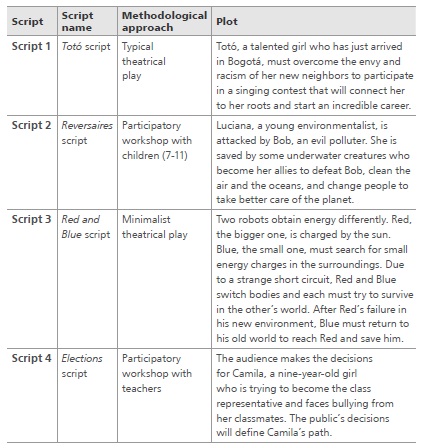
-Script development. For this project, the scriptwriters applied classical writing methodologies, specifically designed to allow students to assume active roles during the performance so that they could influence the development of the plot. Each script adopted a methodological approach and was, therefore, formulated in phases described in table 3.
The first script was written classically, starting with a synopsis and story outline, followed by the first version of the script. Each stage was presented to the team of engineers and educators for feedback and additional ideas.
In contrast, the second script took a participatory approach with the children, where a workshop was held, and they contributed to creating characters, conflicts, and places for the story. The ideas were then transformed into a lengthy synopsis, a detailed story outline, and a final script. The team discussed each phase of the writing process and validated them with the participating children.
Table 3
Script development phase based on theme, approach, and plot
Source: own elaboration.
The third script was conceived with the results of the previous two. The strengths of the robot actors were identified, including their ability to move, turn, and change their eyes expressions. The script was written without dialogue and relied heavily on movement, motion mapping, music, lighting, and art direction.
Finally, the fourth script was devised through a participatory approach with a group of schoolteachers who shared their experiences with bullying, inspiring the initial plot via their narratives. So, to increase the play’s appeal to the audience, the interaction possibility was incorporated. At some points in the story, characters were faced with choices, and the audience could vote for their preferred option through an app. In this way, the public influenced the evolution of the story and the play became more interactive.
Figure 2 shows the methodological steps followed for developing the four scripts created.
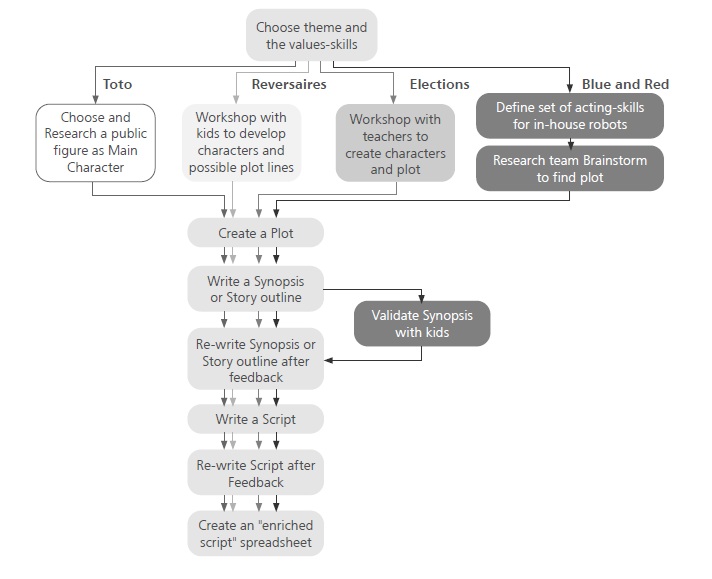 Figure 2
Methodology for creating the scripts
Figure 2
Methodology for creating the scripts
Source: own elaboration.
-Creating enriched script for robots. To program the robot actors, it was necessary to transform the scripts into commands that directed the movements, dialogues, emotions, and sounds of the robots on stage; to this end, “enriched
scripts” were created for them. First, the original script was divided into scenes, and each one was then divided into sequential frames. For each frame, a more detailed description of each character’s activities was specified. A spreadsheet was designed to systematize all the characters’ activities, in which their actions and non-verbal expressions, their movement on stage, their verbal expression, and their emotional state were outlined. The enriched script also
included details about lighting and sound.
Figure 3 shows two frames from script 1, which described the characters’ activities, even though they were not the focus of the original script. The goal was for all robots to show at least some signs of life based on the current context.
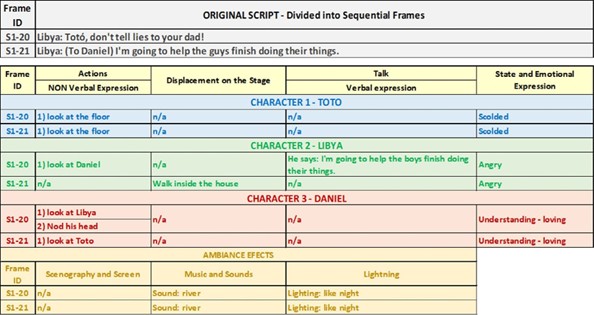 Figure 3
Two frames of the Totó script
Figure 3
Two frames of the Totó script
Source: own elaboration.
-Script selection. After completing the four enriched scripts, a workshop was held with the interdisciplinary team to select one of them to adapt it to ERTP. The
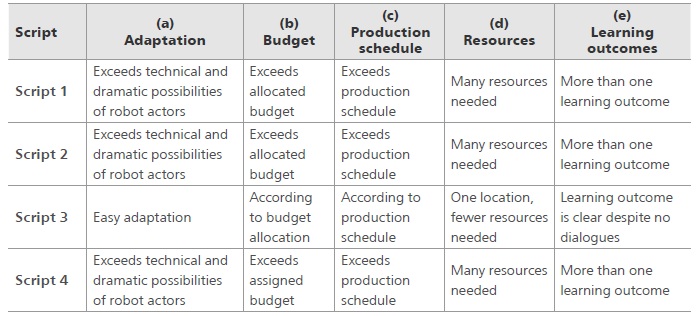
selection criteria included: (a) ease of adaptation for robot actors; (b) budget; (c) production schedule; (d) production resources, such as lighting, set design, robot requirements, and sound; and (e) learning outcomes (table 4).
Table 4
Selection criteria for robot theatrical play
Source: own elaboration.
According to the selection criteria established, Red and Blue was chosen as the play with the highest probability of success in adapting the script
to the stage, a decision based on several factors, such as the ease of relying
on only two characters, one location, and fewer production resources required. In addition, the absence of dialogue and complex actions allowed a simple robot to perform the play, enhancing the transmission of its meaning
through lighting and sound.
-Development of robot actors. Robot actors were designed and developed, specially conceived to meet the needs of the Red and Blue play (figure 4). The built robots had mobility and RGB screens to project emotions through colors and eye-like expressions. Besides, they used lights that indicated their energy levels, associating them directly with their mood. Each robot included a moving element specifically to boost the communication of emotions. For example, the small blue robot was equipped with a tail-like device inspired by a dog. This property reflected its battery level, also contributing considerably to expressing moods through its movement. Similarly, the large red robot carried two movable side antennas that helped to convey emotions visually and dynamically.
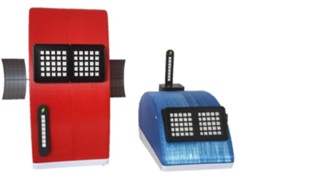 Figure 4
Robot actors to the Red and Blue play
Figure 4
Robot actors to the Red and Blue play
Source: own elaboration.
-Creating a score for the staging of the play. To bring the play to the stage, a new script version was created, called “action score”, with technical indications for programming, lighting, and sound. For the programmer, each scene was divided into three sequences with a list of numbered actions that specified movements on stage, forward, backward, pauses, and turns, as well as eye expressions coded from one to twenty, the percentage of charge that would appear on the battery indicator and the movement of the appendix. Synchronizations with sound effects, music, and lighting were also displayed in each sequence. The action score was halfway between a conventional script and the enriched script spreadsheet, as it followed the actions in a coded and standardized way, but it can still be read as a written work and not as a figure.
-Staging of the robotic theatrical play. The technical team worked on programming movements, non-verbal expressions, and charging indicators, as specified in the action score. The team also synchronized the robot’s activities with the lighting and sound effects the artistic team designed, responding to the robot’s movements, timing, and expressions. Performing the play each time required a programmer to send sequences to the actors, a musician to play the sound effects and melodies, and a lighting designer to work on the cues. The collaboration between the artistic and technical teams culminated in the staging of the play Red and Blue.
Figure 5 shows the result of the ERTP, featuring the robotic actors Red and Blue, along with the lighting and the set design by the teams. The play is set in a darkened room to maximize both the visual impact and the immersive experience. This controlled environment allows the stage lights and robot lights to stand out more effectively, creating an engaging atmosphere. For example, the lights on the robots’ eye screens, designed to reflect their emotional states, are perceived more clearly in this environment, thus significantly increasing the emotional connection with the viewer and highlighting the expressiveness and personality of the robotic characters, making them key elements of the visual narrative.
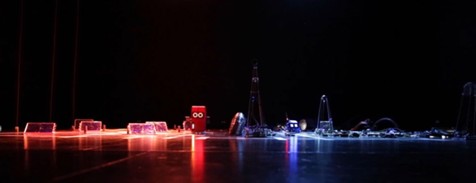 Figure 5
Staging of the Red and Blue play
Figure 5
Staging of the Red and Blue play
Source: own elaboration.
Due to the confinement and security measures prompted by the COVID-19 pandemic 2020, the decision was made to record the work as a
professional video rather than perform it live.
-Forum theatre activity. Twenty-three children between 8 and 12, and eight school teachers (four elementary teachers of subjects unrelated to technology and four of computer science) participated in the research. The activity included the screening of the video Red and Blue and the holding of two
forum theatre activities where participants discussed the story and shared their narrative and character interpretations; then, the Research Ethics Committee of the Faculty of Education of Pontificia Universidad Javeriana granted
the ethical approval, and school teachers handed their informed consents.
During the forum theatre activity, participants responded to the question “What do you think the educational message was about?”. On the one hand, most participants identified an educational topic related to collabo ration and conflict resolution. Red and Blue tells a story of two robots that exchange their bodies due to a short circuit, forcing them to adapt to each other’s environment, ultimately highlighting the significance of empathy, cooperation, and resilience to overcome challenges. The results also showed that the children could understand the story, identify the characters, the learning outcome, and the resources the protagonists used to collaborate and find a solution. Likewise, the children reflected on the conflicts they arose with their classmates at school and the possibilities of resolution found. On the other hand, the participating teachers emphasized the educational value of the proposal and how children can understand empathy as fundamental in the school environment: “I think this kind of stories are important to share with students because we can use them to reflect on different situations that happen at school every day” (SC1, FG schoolteacher, personal communication, May 2022).
To validate the clarity and effectiveness of the play’s narrative, participants responded to questions about the story, considering the absence of dialogue, the single location, the two characters, and the performance of robots. The children identified the tension between Red and Blue and the possibilities of ending the plot. They recognized elements of the music referring
to video games and how it helped them understand some aspects. These insights offer future opportunities for applying ERTP in school settings, where students can take a more active role, interpreting the story in different ways and, for example, creating alternative endings using narrative resources or analog and digital technologies.
For the teachers, the length of the story was appropriate as it allowed them to remain attentive to its development without distractions, the emphasis on robot’s emotions, the use of only two characters and a single scenario facilitated understanding of the story, especially for the younger audience: “The combination of art and programming allowed to convey clear emotions in the play” (SC3, FG schoolteacher, personal communication, May 2022).
During each activity, ERTP screening with high artistic quality in educational settings and diverse audiences were explored. Participating teachers agreed on the educational value of the proposal, highlighting the importance of incorporating robot actors in the plays, given that children are familiar with technological devices and screen environments. They added that using robotic theatre in classrooms is feasible, provided that necessary technological conditions are in place.
Finally, during the simulation of the play, the children could interact
with the robot actors to address creativity and programming, involving them actively in the composition process, despite focusing on a high artistic quality ERTP in forum-theatre format. As Boal (1979/2000) noted, theatre
transforms the audience into an individual who thinks and plays as a group through interactive activities that can enhance engagement with children.
Reflection on the experience
This section addresses the SE reflections, which subsequently allow for the establishment and proposal of a methodology for creating an ERTP.
-Organization of the phases in ERTP development. Initially, scripts were explored to determine the type of robots required since the methodology proposes that the work should notice the technical limitations and the specific ways robots can convey emotions.
Also, the sequencing of the phases offers the possibility of defining from the beginning the role of the participating students, ensuring clarity and access to the necessary resources provided by the organization or educational institution receiving the project. As an active audience, students would influence technical and narrative aspects that support the development of the ERTP (Barnes et al., 2017, 2020).
-Narratives, formats, and technologies. For robotic actors, a different script structure is necessary because traditional ones lack the detailed information to perform a semi-professional theatrical play. Robot’s emotions, expressions, and coordination of movements are more complex than in conventional theatre.
Moreover, it is convenient to develop a system that automatically converts the theatrical script into a computational model robots can interpret, enabling them to perform and refine the plot.
Similarly, a control method is needed to ensure the correct synchronization of robot actors’ actions with other stage elements, such as music, lighting, and even human actors. An ideal model would manage interactions with the latter or the audience while supervising the execution of the entire theatrical script.
In short, it is essential to design robot actors capable of conforming to a theatrical script and credibly playing a character moves away from the stage axis.
-Learning objectives and role of the participating students. Within the ERTP methodology, it is convenient to deepen in learning approach. Although the selected topics and the narrative development harmonized with the training goals, the most prominent effort focused on the narrative and technical design required for the ERTP, as well as on its presentation format. Future work needs a more profound study in this area, especially in the roles executable by the participating students (Barnes et al., 2020; Szecsei, 2019). In this sense, incorporating interactivity when performing would allow the audience to be actively involved. Including transmedia storytelling in the ERTP would offer new opportunities for students and teachers, enriching the learning experience.
-Interdisciplinary work and collaboration. Above all the technical, educational, and artistic tasks, there was an overarching challenge for interdisciplinary work (Hakkarainen & Vapalahti, 2011): getting artists, engineers, and educators to communicate effectively and move with some comfort in each other’s field of expertise. The artists had to become familiar with the robotics lab to understand the machines, whilst the engineers had to think creatively and devise new possibilities, leading them to step outside their usual patterns of behavior and to new practices for ERTP.
Lessons learned from the experience
-Proposed methodology. Following the
experiences of implementing an ERTP, this section systematized them into a replicable methodology. It is
important to emphasize that neither students nor teachers were involved in the
creation of the work nor the programming of the robots.
The main objective was for students to achieve the intended learning outcomes through well-designed robotic plays and subsequent discussions in a forum theatre format. This model insisted on the artistic quality of the performance, offering an innovative educational approach that combined the aesthetic value of theatre with the interactivity of robots and represented
complementarity and validity in applying robotic theatre in the classroom. Unlike students participating in the entire process of creating the play —prioritizing learning but not necessarily artistic quality, this proposal aimed to transcend traditional educational environments; therefore, the robotic theatre performances possess the potential to be adapted to diverse contexts, such as museums, theatres, cultural centers, as well as school settings and other venues for scientific and artistic outreach, thereby expanding their range and impact. Figure 6 shows the seven-phase methodology.
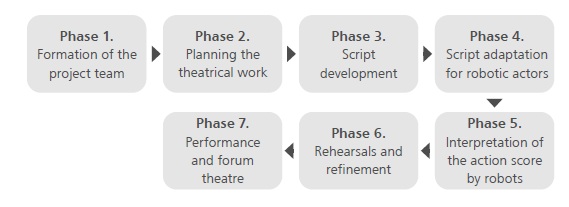 Figure 6
Phases of the ERTP methodology
Figure 6
Phases of the ERTP methodology
Source:
-Phase 1. Formation of the project team. The objective was to assemble an interdisciplinary team integrating expertise from various fields to ensure project success. Education professionals played a key role in guiding
the development of scripts and planning the forum theatre to align with the learning
objectives. Software and robotics engineers became essential to designing and programming robotic actors or adapting commercial robotic platforms to interpret the script. Furthermore, the involvement of artists, including scriptwriters, stage managers, art directors, and lighting and sound professionals, was crucial to creating and staging theatrical performances.
-Phase 2. Plannig the theatrical work. This stage defined the learning
objectives, the play theme, the type of robot actors, their expressive abilities,
and the strategy for the script development. It was decisive to determine the role of the students during the ERTP, which implied deciding whether they would act only as spectators, they would participate interactively by influencing the actions of the robot actors, or whether they would have an active role in the staging together with
them.
It was also worth considering the capabilities of robots, as scripts for humanoid robots differ significantly from scripts for mobile robots that merely emit sounds and lights. This phase was pivotal to aligning the narrative with the technological capabilities of the robotic actors, confirming that the work was engaging and technically feasible.
It involved selecting or developing robotic actors consistent with the specific requirements of the script: either commercially available or custom-built to fit the narrative and scenic needs. So, it was essential to determine the robot control mechanism through individual programming with manual synchronization or centralized coordination software. Due to the absence of ready-made solutions for the synchronization of multiple robots in theatrical performances, it may be necessary to develop custom software to monitor the robot actors and ensure synchronization with audio, lighting, and other stage elements.
-Phase 3. Script development. This phase consisted of creating scripts that fit the previously defined educational objectives. For scriptwriting, traditional narrative development methodologies are adapted, such as plot creation, synopsis writing, and detailed plot development. Throughout the process, constant feedback should be maintained to adjust and refine the storylines according to the pedagogical objectives and the technical capabilities of the robot actors.
-Phase 4. Script adaptation for robotic actors. The developed script must be adapted to facilitate the programming of robot actors and their integration with the artistic
elements of the staging, such as sound and lighting. Called the action score, this adaptation transforms the high-level narrative into specific technical instructions according to the capabilities of the robot actors.
The action score served as a structured sequence of physical, vocal, and emotional actions for the robots, encompassing non-verbal expressions (commanding a robot to look at another character), verbal expressions (activating the reproduction of a specific sound), scenic movements (placing a robot in a precise location) and emotional states (programming it to show “sadness” or “happiness”).
Additionally, the action score incorporates music and lighting cues, fostering seamless interactions between robots and artistic aspects of the performance.
-Phase 5. Interpretation of the action score by robots. This phase centered on enabling the robots to perform the script convincingly, programming them to show emotion, deliver dialogue, and coordinate movements to convey the narrative effectively. Collaboration with the artistic team was vital to ensure that
the robotic performance matched the creative vision, combining technical precision with artistic expression. For example, determining how a robot might look “sad” or “happy” requires detailed programming
and artistic guidance.
-Phase 6. Rehearsals and refinement. In the rehearsal phase, the performance of the robot actors was verified, as well as the synchronization between them and the artistic features, such as lighting and sound, ensuring smooth coordination between the robots’ movements, sound effects, and stage dynamics. In the case of interactive works involving audience participation, this phase also includes testing and adjusting the interaction mechanisms, ensuring that the audience’s decisions effectively influence the development of the plot and the performance of robots. The results of the rehearsals become fundamental to introduce iterative improvements to both the script and the programming of the robots, allowing for adjustments to technical and artistic details that enhance the audience’s experience and ensure proper execution of the script in the final presentation.
-Phase 7. Performance and forum theatre. The final phase consisted of presenting the play to the target audience, followed by a forum theatre session, where the audience participated in thoughtful discussions or interactive activities inspired by the performance, allowing them to delve deeper into the themes. This stage culminated the interdisciplinary effort, integrating education, robotics, and art in an engaging and innovative format.
Conclusions
Using an interdisciplinary methodology for ERTP offers new possibilities for developing educational scenarios in which technology plays a key role; it has demonstrated the potential of combining edutainment with robotic theatre in an instructional setting to achieve learning outcomes. As a strategy, the ERTP methodology engages and motivates children and teachers while delivering learning messages in a forum theatre format. However, designing an interdisciplinary system to create, stage, and perform ERTP with high artistic quality presents technical, educational, and aesthetic challenges. Since this is still an exploratory discipline, it would be valuable to address the portability of the ERTP methodology to different education settings, provide guidelines to facilitate interdisciplinary work, and ensure knowledge transfer to educators.
Future research projects in this area could explore more complex methodologies and include multiple courses of action and active audience participation. In addition, the possibility of combining human and robot actors on stage should be further reviewed, as well as highlighting the added value of skill acquisition in a performance with robots compared to one with human actors, an exercise that would provide deeper insight into the unique educational benefits and challenges of robotic theatre.
It should be noted that limitations of this project included the impact of the COVID-19 pandemic, which prevented the live performance of the play Red and Blue during the forum theatre simulation activity.
About the authors
Rocío Lopez-Ordosgoitia holds a PhD in Information and Communication Sciences from the University of Lille, France. She is a lecturer and researcher at the Faculty of Education, Pontificia Universidad Javeriana, Colombia. She belongs to the research group Training, Subjectivities, and Policies.
Flor Ángela Bravo-Sánchez holds a PhD in Engineering from the Pontificia Universidad Javeriana, Colombia. She is an assistant professor at the National University of Colombia in La Paz, Cesar, Colombia. She is a member of the Nanostructures and Applied Physics (Nanoupar) research group. Her current research focuses on robotics, human-robot interaction, intelligent systems, STEAM education, and engineering education.
José Alejandro Convers-Elías is a writer and teacher with twenty years of experience in creating audiovisual content for multiple formats, specializing in content for children and young people. His most recent work, "El club de los graves" can currently be seen on Disney+. He is a professor in the Performing Arts program at the Pontificia Universidad Javeriana, Colombia. He developed the somatics area and the somatic education program.
Victor-Alfonso Quesada-Aguilar is a political scientist with a master's degree in theater direction from the University of Essex in England. He was coordinator of the acting and staging areas in the Performing Arts program at the Pontificia Universidad Javeriana in Colombia. He currently leads creative projects in theaters, channels, and platforms in Colombia.
Mónica Ilanda Brijaldo-Rodriguez is a research professor at the Faculty of Education, belongs to the Innovum Educatio research group, and is currently the director of the Training Department at the Pontificia Universidad Javeriana, Colombia.
Enrique González is a professor at the Faculty of Systems Engineering, Pontificia Universidad Javeriana, Colombia. He holds a PhD in computer science from the University of Évry Val d'Essone, France. His latest research focuses on robotics, artificial intelligence, and complex systems simulation.
References
Atkinson, D. (2002). Art in education: Identity and practice. Kluwer Academic Publishers.
Barnes, J., FakhrHosseini, M., Vasey, E., Duford, Z., & Jeon, M. (2017). Robot theatre with children for STEAM education. Proceedings of the Human Factors and Ergonomics Society Annual Meeting, 61(1), 875-879. https://doi.org/10.1177/1541931213601511
Barnes, J., FakhrHosseini, M., Vasey, E., Park, C. H., & Jeon, M. (2020). ChildRobot theatre: Engaging elementary students in informal STEAM education using robots. IEEE Pervasive Computing, 19(1), 22-31. https://doi.org/10.1109/MPRV.2019.2940181
Boal, A. (1979/2000). Theatre of the oppressed. Pluto Press.
Bravo, F. A., & Páez, J. J. (2023). Exploring the use of multiagent systems in educational robotics activities. IEEE Transactions on Learning Technologies, 16(6), 970-982. https://doi.org/10.1109/TLT.2023.3277715
Celis-Buitrago, K. J., Pineda, N. A., & Gómez, P. M. (2020). COBOT: Teatro robótico educativo orientado a las emociones y el realismo [Degree project, Universidad Javeriana]. Repositorio Institucional Javeriano. http://hdl.handle.net/10554/52588
Csikszentmihalyi, M. (2014). The systems model of creativity. Springer.
Dong, J., Choi, K., Yu, S., Lee, Y., Kim, J., Vajir, D., Haines, C., Newbill, P., Wyatt, A., Upthegrove, T., & Jeon, M. P. (2023). A child-robot musical theatre afterschool program for promoting STEAM education: A case study and guidelines. International Journal of Human-Computer Interaction, 40, 34653481. https://doi.org/10.1080/10447318.2023.2189814
Dong, J., Mitchell, J. J., Yu, S., Harmon, M., Holstein, A., Shim, J. H., Choi, K.,Zhu, Q., & Jeon, M. (2024, March). Promoting STEAM education and AI/robot ethics in a child-robot theatre afterschool program [Conference paper]. Companion of the 2024 ACM/IEEE international conference on humanrobot interaction, Boulder, Colorado, USA. https://vtechworks.lib.vt.edu/server/api/core/bitstreams/5b4d043b-2e05-49b4-94bb-85cd593b65c1/content
Eckersall, P., Grehan, H., & Scheer, E. (2017). Robots: Asleep, awake, alone, and in love. In P. Eckersall, H. Grehan, & E. Scheer, New media dramaturgy (pp. 107-134). Palgrave Macmillan.
Flintoff, K. (2005). Drama and technology: Teacher attitudes and perceptions. Edith Cowan University.
Guimarães, H., Fonseca, C., Gonzalez, C., & Pinto-Correia, T. (2017). Reflecting on collaborative research into the sustainability of Mediterranean agriculture: A case study using a systematization of experiences approach. Journal of Research Practice, 13(1). https://www.researchgate.net/journal/Journal-of-Research-Practice-1712-851X?_tp=eyJjb250ZXh0Ijp7ImZpcnN0UGFnZSI6InB1YmxpY2F0aW9uIiwicGFnZSI6InB1YmxpY2F0aW9uIn19
Hakkarainen, P. & Vapalahti, K. (2011). Meaningful learning through video-supported forum-theatre. The International Journal of Teaching and Learning in Higher Education, 23, 314-328. https://www.isetl.org/ijtlhe/pdf/IJTLHE1047.pdf
Horáková, J. (2011). Looking backward at the robot. In D. Obdržálek & A. Gottscheber (Eds.), Research and Education in Robotics–EUROBOT 2011, Communications in Computer and Information Science, 161. Springer. https://doi.org/10.1007/978-3-642-21975-7_1
Jara-Holiday, O. (2018). La sistematización de experiencias: Práctica y teoría para otros mundos posibles. Centro Internacional de Educación y Desarrollo Humano-CINDE. https://repository.cinde.org.co/bitstream/handle/20.500.11907/2121/Libro%20sistematizacio%cc%81n%20Cinde-Web.pdf?sequence=1&isAllowed=y
Ko, S., Swaim, H., Sanghavi, H., Dong, J., Nadri, C., & Jeon, M. (2020, April 1). Robot-Theatre programs for different age groups to promote STEAM education and robotics research [Conference paper]. HRI ’20: Companion of the 2020 ACM/IEEE international conference on human-robot interaction, New York, NY, USA.
Mitchell, J. J., Dong, J., Yu, S., Harmon, M., Holstein, A., Shim, J. H., Choi, K., Zhu, Q., & M. Jeon. (2024, March 11-15). Bridging the gap: Early education on robot and AI ethics through the robot theatre platform in an informal learning environment [Conference paper]. Companion of the 2024 ACM/ IEEE international conference on human-robot interaction, Boulder, CO, USA. https://dl.acm.org/doi/pdf/10.1145/3610978.3640581
Nijholt, A. (2018, July). Robotic stand-up comedy: State-of-the-art [Conference paper]. Distributed, ambient and pervasive interactions: Understanding humans 6th international conference, Las Vegas, NV, USA. http://dx.doi.org/10.1007/978-3-319-91125-0_32
Páez Rodríguez, J. J. (2019). Interacción humano-robot: Consideraciones de implementación en ambientes escolares (Human-robot interaction: Implementation considerations in school environments). Noria Investigación Educativa, 1(3).
Sanoubari, E., Johnson, A., Muñoz, J. E., Houston, A., & Dautenhahn, K. (2023). Using robot-mediated applied drama to foster anti-bullying peer support. In R. Hakli, P. Mäkelä, & J. Seibt (Eds.), Social robots in social institutions (pp. 194-203). IOS Press. http://dx.doi.org/10.3233/FAIA220618
Sawyer, R. K. (2014). Group creativity: Music, theatre, collaboration. Psychology Press.
Sone, Y. (2017). Japanese robot culture. Palgrave Macmillan.
Sovhyra, T. (2021). Robotic theatre: Comparative analysis of human and mechanized activities in the creative process. Creativity Studies, 14(2), 295-306. https://doi.org/10.3846/cs.2021.13545
Spolin, V. (1963). Improvisation for the theatre. Northwestern University Press.
Szecsei, D. (2019, February 27). Theatrical performances using robots as actors [Conference paper]. 2019 Research on equity and sustained participation in engineering, computing, and technology (RESPECT), Minneapolis, MN, USA. https://doi.org/10.1109/RESPECT46404.2019.8985868
Thambu, N., Shanmugavelu, G., & Mahayudin, Z. (2020). The use of forum theatre as creative pedagogy in teaching and learning of moral education in secondary schools in Malaysia. EPRA International Journal of Multidisciplinary Research (IJMR), 6(8), 315-324. https://doi.org/10.36713/epra4961
Thamdrup, C., Smith, C., Dieckmann, P., Belsi, A., & Nestel, D. (2024). Using Forum Theatre techniques in teaching and learning about professionalism
and
communication in healthcare. International Journal of
Healthcare Simulation. https://doi.org/10.54531/lfss8468
Tobar, J. B., Prócel, A., Loza, D., Caicedo, E., & Bacca, B. (2021). Autism Robotic Theater: a technological tool to contribute to the socialinteraction of children diagnosed with autism spectrum disorder. Periodicals of Engineering and Natural Sciences (PEN), 9(3), 548-567.
Author notes
flbravos@unal.edu.co
Additional information
Descripción del artículo | Article description | Descrição do artigo: Este artículo de investigación hace parte de la metodología desarrollada en el marco de la investigación Quyca-Bot: Creación de guiones para dramatizaciones
con robots actores para propósitos educativos, financiado
por la Pontificia Universidad Javeriana, Colombia. Para ver la obra Rojo y Azul,
consultar: https://catalogodeobras.javeriana.edu.co/items/show/622
Para citar este
artículo | To cite this article | Para citar este artigo : Lopez-Ordosgoitia, R., Bravo-Sánchez, F., Convers-Elías, J., Quesada-Aguilar, V.A., Brijaldo-Rodriguez, M. & González, E. (2025). Creation, staging, and performance of educational theatre plays using robot actors. magis, Revista Internacional de Investigación en Educación, 18, 1-23. doi:https://doi.org/10.11144/Javeriana.m18.cspe