Teachers’ autonomy support and homework effort: Moderated mediation of psychological control and autonomous motivation *
Apoyo a la autonomía y esfuerzo en tareas: Moderación mediada del control y la motivación
Angel Alberto Valdés-Cuervo
, Michel Velderrain-Valenzuela
, Christian Samhir Grijalva-Quiñonez
, Agustín Morales-Álvarez
, Lizeth Guadalupe Parra-Pérez
Teachers’ autonomy support and homework effort: Moderated mediation of psychological control and autonomous motivation *
Universitas Psychologica, vol. 24, 2025
Pontificia Universidad Javeriana
Angel Alberto Valdés-Cuervo a angel.valdes@itson.edu.mx
Technological Institute of Sonora, México
Michel Velderrain-Valenzuela
Technological Institute of Sonora, México
Christian Samhir Grijalva-Quiñonez
Technological Institute of Monterrey,, México
Agustín Morales-Álvarez
Technological Institute of Sonora, México
Lizeth Guadalupe Parra-Pérez
Technological Institute of Sonora, México
Received: 18 june 2025
Accepted: 05 november 2025
Resumen: Las prácticas docentes que apoyan la autonomía se han asociado con comportamientos positivos del estudiantado en relación con las tareas escolares. Sin embargo, se conoce poco sobre los mecanismos que explican esta asociación. Este estudio examinó cómo las percepciones de los estudiantes sobre las prácticas docentes de apoyo a la autonomía se relacionan con su esfuerzo en las tareas a través de la motivación autónoma, y si las prácticas psicológicamente controladoras percibidas moderan este proceso. La muestra incluyó estudiantes mexicanos de primaria y secundaria. Se evaluó un modelo de mediación moderada. Los resultados mostraron que la percepción estudiantil del apoyo docente a la autonomía se asoció positivamente con el esfuerzo en las tareas, y que la motivación autónoma de los estudiantes para hacer las tareas medió parcialmente esta relación. Aunque el control psicológico percibido no moderó el vínculo entre el apoyo a la autonomía percibido y la motivación autónoma, sí moderó la relación entre el apoyo a la autonomía percibido y el esfuerzo en las tareas. El efecto positivo del apoyo a la autonomía fue significativo únicamente cuando los niveles de control psicológico percibido eran bajos, lo que resalta el papel perjudicial de las prácticas controladoras en el esfuerzo del estudiantado hacia las tareas escolares.
Palabras clave:profesorado, apoyo a la autonomía, control psicológico, motivación autónoma, esfuerzo en las tareas.
Abstract: Teachers' autonomy-supportive practices have been associated with positive student behaviors in homework. However, little is known about the underpinnings of this association. This study examined how students’ perceptions of teachers' autonomy-supportive practices relate to their homework effort through autonomous motivation, and whether perceived psychologically controlling practices moderate this process. The sample involved Mexican elementary and secondary students. A moderated mediation model was tested. Results showed that students’ perception of teachers’ autonomy-supportive practices was positively associated with homework effort, and students’ autonomous motivation for homework partially mediated this relationship. Although perceived psychological control did not moderate the link between perceived autonomy support and autonomous motivation, it did moderate the relationship between perceived autonomy support and homework efforts. The positive effect of perceived autonomy support on effort was significant only under low levels of perceived psychological control, highlighting the detrimental role of controlling practices in students’ homework effort.
Keywords: teachers, autonomy support, psychological control, autonomous motivation, homework effort.
Homework is an indispensable component of the education system, as it encourages students to develop self-regulated learning and improves their academic performance (Ozyildirim, 2022; Rosário et al., 2018). In line with educational practices, teachers assign homework for students to complete outside class hours (Cooper et al., 2001). Nonetheless, for homework to be truly effective, students must be willing to invest the necessary effort (Fan et al., 2017; Göllner et al., 2017; Yang & Tu, 2019). This effort encompasses compliance, investment, concentration, and task completion (Trautwein et al., 2006). The amount of effort dedicated to homework positively influences both academic and non-academic outcomes for students (Göllner et al., 2017; Rosário et al., 2018; Xu & Corno, 2022; Xu et al., 2021; Xu et al., 2018). Given the role of homework effort in shaping student academic success, it is crucial to explore the factors that affect the effort students invest in completing their homework. The academic community continues to debate the factors that influence students' homework efforts. While some researchers assert that individual student characteristics influence effort in homework, others argue that socialization agents, such as teachers, play a pivotal role in motivating students to exert effort in their homework (Cunha et al., 2019; Xu, 2024).
Students’ perceptions of teachers’ autonomy support and psychological control in relation to homework effort
The Self-Determination Theory [SDT] (Ryan & Deci, 2017) posits that fulfilling the basic psychological needs of autonomy, competence, and relatedness fosters positive development. According to SDT, satisfying these psychological needs promotes goal-oriented behaviors and overall well-being, while their frustration is linked with dysfunction and ill-being. Vansteenkiste and Ryan (2013) indicate that individuals thrive, grow, and flourish in contexts that support these needs; conversely, in a need-threatening environment, they may resort to defensive strategies that lead to non-optimal functioning. The SDT highlights that autonomy support fosters the need-supporting context, whereas psychological control tends to create a need-threatening context (Bradshaw et al., 2025; Haerens et al., 2015; Jang et al., 2016).
According to SDT, teachers may adopt both autonomy-supportive and psychologically controlling practices. Students' perceptions of teachers' autonomy-supportive practices are essential for fostering self-motivation and academic performance, as such practices acknowledge students' perspectives and engage them in age-appropriate decision-making. These perceptions reflect students' experiences of teachers who explain the rationale behind rules, offer meaningful choices, demonstrate empathy, encourage open discussion, and support students' sense of initiative (Grolnick & Lerner, 2023; Ryan & Deci, 2017). The positive effect of students' perception of autonomy-supportive practices on academic performance is well documented (Cheon et al., 2020; Domen et al., 2020).
Conversely, perceived psychologically controlling practices occur when teachers attempt to manipulate students' thoughts, feelings, and behaviors through coercion, external pressures, or conditional rewards. Students perceived controlling practices when teachers withdrew affection, made psychological threats, and induced feelings of guilt (Donald et al., 2021; Ryan & Deci, 2017; Ryan et al., 2023). Research indicates that perceived psychological controlling practices harm students' academic outcomes (Benita & Matos, 2021; Patall et al., 2019; van der Kaap-Deeper et al., 2017; Wang & Hu, 2022). Within the SDT framework, studies have examined the influence of perceived autonomy-support and psychological control on students’ homework behaviors. Findings consistently reveal that students’ perception of autonomy-supportive practices encourages positive homework effort, whereas perception of psychological controlling practices undermines students' homework effort (Feng et al., 2019; Soenens et al., 2012; Xu, 2016; Xu et al., 2021).
The mediating role of autonomous motivation
Completing homework can be particularly challenging for students due to competing demands on their time, limited teacher oversight, and various environmental distractions (Katz et al., 2009). To manage these challenges effectively, students must rely on motivationally driven behaviors, such as time management, self-regulated learning, and persistence (Özcan, 2015; Suárez et al., 2019; Valle et al., 2019). However, the motivational mechanisms through which perceived teacher practices influence homework effort remain insufficiently explored. Self-Determination Theory [SDT] (Ryan & Deci, 2017) offers a useful framework for understanding these mechanisms by distinguishing between controlled and autonomous forms of motivation. Autonomous motivation arises from personal interest, internalized values, and a sense of volition (Deci & Ryan, 2008; Ryan & Deci, 2017), and has been consistently identified as a key psychological driver of students' academic engagement and persistence—especially in the context of homework (Feng et al., 2019; Hagger et al., 2015; Patall et al., 2019). Students who are autonomously motivated are more likely to sustain effort, overcome obstacles, and produce higher-quality work (Datu et al., 2018; Howard et al., 2021).
Teachers' autonomy-supportive practices, as perceived by students, are recognized as a critical contextual factor in fostering the internalization of student motivation (Banerjee & Halder, 2021; Reeve & Cheon, 2021). Numerous studies have highlighted the positive effects of perceived teachers' autonomous support; however, only Feng et al. (2019) have specifically examined the mediating role of autonomous motivation in the relationship between perceived teacher autonomy-supportive practices and students' performance. Their findings indicate that autonomous motivation serves as a mediator in this relationship. Nonetheless, the study does not address whether this process is influenced or moderated by other perceived teacher behaviors, such as psychologically controlling practices.
The moderate effect of perceived teacher psychological-controlling practices
Recent research increasingly challenges the traditional view that autonomy support and psychological control exist on opposite ends of a single continuum (Amoura et al., 2015; Gong & Wang, 2021; Kunz & Grych, 2013; McCurdy et al., 2020). Instead, scholars argue that autonomy support and psychological control are distinct yet interrelated dimensions of teacher behavior. This conceptual differentiation has significant implications for understanding how teachers influence student outcomes. Notably, low levels of psychological control do not necessarily indicate the presence of autonomy-supportive practices. In other words, reducing controlling behaviors does not automatically enhance students' sense of agency or encourage their voluntary engagement in academic tasks. In practice, teachers may simultaneously employ autonomy-supportive and psychologically controlling strategies—particularly in homework contexts, where there is often pressure to direct student behavior. This nuanced perspective highlights the complexity of teacher-student interactions and emphasizes the need to examine how these practices coexist within the classroom rather than treating them as mutually exclusive.
Despite this theoretical advancement, limited empirical research has examined the potential interaction between these two dimensions of teacher behavior. Scholars such as Amoura et al. (2015) and Grolnick and Lerner (2023) have emphasized the need to investigate how perceived autonomy support and psychological control may shape students’ motivation and learning behaviors. However, empirical evidence on this interplay remains scarce. In particular, no study to date has examined whether students’ perceptions of teachers’ psychologically controlling practices moderate the direct effect of perceived autonomy-supportive teaching on homework effort or its indirect effect through autonomous motivation.
The present study
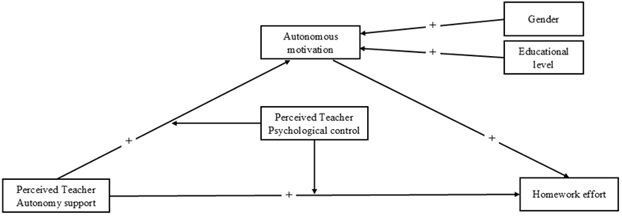
To address the existing gaps in the literature, this study examined the relationship between students’ perception of teachers’ practices and their homework effort. Specifically, it pursued three main objectives. First, the study analyzed the direct relationships among perceived teacher autonomy-supportive practices, autonomous motivation, and homework effort. Second, it tested whether students’ autonomous motivation mediated the link between perceived teachers’ autonomy support and students’ homework effort. Third, it examined whether perceived teacher psychological control moderated the associations between perceived autonomy support, autonomous motivation, and homework effort (see Figure 1). Given previous research evidence of potential differences in motivation and homework behaviors based on student gender and age (Flunger et al., 2017; Gershenson & Holt, 2015; Kackar et al., 2011; Núñez et al., 2015; Skinner et al., 2016), these variables were statistically controlled to prevent them from confounding the observed relationships among the study variables.
Building on prior research, we propose the following hypotheses: Hypothesis 1. Students’ perceptions of teachers’ autonomy-supportive practices will be positively associated with their autonomous motivation and homework effort. Hypothesis 2. Students’ autonomous motivation will be positively associated with their homework effort. Hypothesis 3. Students’ autonomous motivation will mediate the relationship between students’ perceived teachers’ autonomy-supportive practices and students’ homework effort. Hypothesis 4. Students’ perceptions of teachers’ psychological controlling practices will moderate the relationships between perceived autonomy support and (a) autonomous motivation and (b) homework effort, such that the positive effects of perceived autonomy support will weaken under conditions of high perceived psychological control.

Method
Design
This study employed a cross-sectional correlational design to examine the relationships among students’ perceptions of teachers’ practices, autonomous motivation, and homework effort.
Participants
The sample comprised 1,500 students from a city in Sonora, Mexico, including 750 elementary school students (5th and 6th grades) from 15 schools and 750 middle school students from another 15 schools. A non-probabilistic convenience sampling method was employed to select the participating schools. All institutions involved were public urban schools characterized by a low marginalization index, primarily serving middle-and low-income students. The selected school represented various geographical areas of the city. Within each participant's school, the researcher selected one classroom at the designated grade level for convenience to complete the questionnaires. Among the elementary students, 47 % were male, with a mean age of 10.62 years (SD = 0.84). In comparison, the middle school population consisted of 44 % males, with a mean age of 13.40 years (SD = 0.99).
Measures
Perceived teacher autonomy support
The scale designed to evaluate students' perceptions of teacher autonomy support in homework was developed based on previous research (Awang-Hashim et al., 2017; Liu & Chung, 2014; Núñez et al., 2012). It evaluates the extent to which teachers provide meaningful rationales, acknowledge students' perspectives, and encourage choice and self-regulation in homework activities. The instrument comprises seven items, including examples such as: "My teacher listens to my opinions when I encounter a problem with homework." The internal consistency of the scale was adequate, with McDonald's Omega (ω) = 0.85. Students responded on a five-point Likert-type scale ranging from 1 (never) to 5 (always). Confirmatory Factor Analysis (CFA) supported the model's adequacy, indicating a good fit to the data: SBχ²(9) = 13.75, p = 0.131; SRMR = 0.02; TLI = 0.98; CFI = 0.99; RMSEA = 0.03, 90 % CI [0.01, 0.05].
Perceived teacher psychological control
Perceived teacher psychological control during the homework process was assessed using a scale adapted from prior research in the field (Jang et al., 2016; Soenens et al., 2012; Trautwein et al., 2006). The scale measures the extent to which teachers use controlling strategies—such as guilt induction, love withdrawal, or excessive pressure —to influence students’ homework behavior. The instrument comprises 10 items; a representative example is: "When my teacher is not satisfied with how I did my homework, he/she makes me feel guilty”. Participants responded using a five-point Likert-type scale, with anchors ranging from 1 (never) to 5 (always). The scale demonstrated good internal consistency (ω = 0.82). A CFA further confirmed the model's fit to the data: SBχ²(21) = 34.06, p = 0.036; SRMR = 0.03; TLI = 0.98; CFI = 0.99; RMSEA = 0.03, with a 90 % confidence interval of [0.01, 0.05].
Autonomous motivation
Autonomous motivation for homework was assessed using the scale developed by Katz et al. (2011), which includes nine items that evaluate students’ self-endorsed reasons for completing homework. The items were translated into Spanish following a rigorous back-translation procedure to ensure linguistic accuracy and conceptual equivalence. A representative item is: “I do my homework because I understand it helps me succeed in school.” Students responded on a five-point Likert-type scale ranging from 1 (never) to 5 (always). The scale showed good internal consistency (ω = 0.88). CFA indicated an adequate model fit: SBX ²(21) = 45.86, p = 0.001; SRMR = 0.04; TLI = 0.97; CFI = 0.99; RMSEA = 0.04, 90 % CI [0.03, 0.07].
Homework effort
The Homework Effort Scale (Xu, 2023) was adapted to measure students’ energy and determination when completing their homework across various classes. The scale comprises four items that assess how students manage their personal and environmental resources while completing homework (e.g., “I do my best on my homework,” ω = 0.79). It was rated on a Likert-type scale (1 = never to 5 = always). The CFA showed an acceptable fit to the data (SB X ² = 10.51, df = 7, p = 0.161; SRMR = 0.02; TLI = 0.99; CFI = 0.99; RMSEA = 0.03, 90 % CI [0.02, 0.06]).
Control variables
Two control variables included gender (0 = male, 1 = female) and educational level (0 = elementary school, 1 = middle school).
Procedure
The University Ethics Committee approved the study, and school authorities were informed about the research's objectives, granting permission to access the students. Following this, parental consent was secured, and students were invited to complete questionnaires during school hours in their classrooms voluntarily. All participating students provided signed consent forms. Data were collected through student self-reports, which may be susceptible to common method variance (CMV) bias. To mitigate this bias, several proactive measures were implemented. First, a one-week interval was observed between the administration of the input variables (perceived teacher autonomy support, perceived teacher psychological control, and students’ autonomous motivation) and the output variable (homework effort). Additionally, to reduce social desirability bias, students were assured of anonymity and informed that there were no right or wrong answers on the questionnaires (Podsakoff et al., 2003).
Data Analysis
Preliminary analysis
It is important to note that there were no missing data in the current analysis. To assess the potential influence of Common Method Variance (CMV), the Unmeasured Latent Method Construct (ULMC) approach was employed. This method compares a baseline model that includes only the substantive variables with an augmented model that incorporates latent method factors without specific theoretical meaning (Williams & McGonagle, 2016). The comparison revealed a non-significant difference in chi-square values between the two models (ΔX² = 2.13, df = 1, p = 0.287). Moreover, the variance explained by the unmeasured latent method construct was below the 50 % threshold (28 %). These results indicate that CMV did not constitute a significant source of bias in the current analysis.
Means, standard deviations, and Spearman’s correlations were computed for all study variables. Thresholds established in the literature were used to assess the practical significance of these correlations (Funder & Ozer, 2019). Specifically, a correlation coefficient (r) exceeding 0.10 was classified as indicative of a small effect size, values greater than 0.20 represented a medium effect size, and coefficients greater than 0.30 were interpreted as reflecting a large effect size.
Probing mediation and moderation
To probe the mediating and moderating effects of autonomous motivation and psychological factors, respectively, the PROCESS macro 4.2 for SPSS (Hayes, 2022) was used, enabling regression-based path analysis among the included variables. First, Model 4 was applied to examine the mediating role of autonomous motivation. Secondly, Model 8 was applied to examine the moderating effect of perceived psychological control in the relationships between perceived teacher autonomy support and students’ autonomous motivation and homework effort. We used the standard 5,000-resample bootstrapping method with a 95 % confidence level. If the confidence interval did not contain zero, the effect of the independent variable on students’ homework effort through the mediating variable was deemed statistically significant. Before analysis, the predictor variable was mean-centered, as recommended by Little et al. (2006). Finally, the model's explanatory power was determined using the coefficient of determination (R2 ).
Results
Preliminary analysis
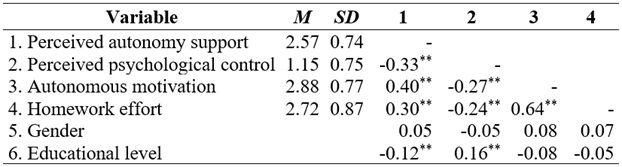
Table 1 presents the means, standard deviations, and Spearman's correlations for the study variables. The results indicate that students perceived teachers' use of autonomy-supportive practices as occasional, whereas teachers' use of psychologically controlling practices was perceived as rare. Students also reported engaging in autonomous motivation and investing effort in their homework only occasionally. Furthermore, the Spearman's correlation analysis revealed a positive relationship among perceived teacher autonomy-supportive practices, students' autonomous motivation, and homework effort. In contrast, perceived psychologically-controlling practices were negatively correlated with these variables. A positive relationship was also observed between students' autonomous motivation and their homework effort. Finally, gender and educational level did not show significant correlations with autonomous motivation or homework effort and were therefore omitted from the path model.

Testing for the mediating effect of students’ autonomous motivation
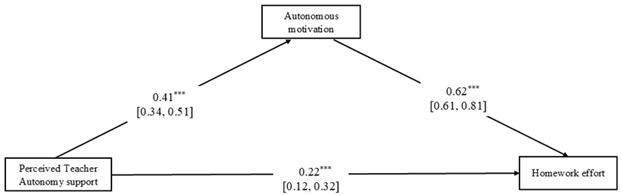
The model explained 41 % of the variance in the homework effort. The results indicate that students' perception of teacher autonomy support significantly predicted their autonomous motivation (β = 0.41, t = 10.14, p < 0.001, 95 % CI [0.32, 0.52]). In turn, autonomous motivation positively affected students' homework effort (β = 0.62, t = 16.36, p < 0.001, 95 % CI [0.61, 0.81]). The direct link between perceived teacher autonomy support and students' homework effort was also significant and positive (β = 0.22, t = 5.96, p < 0.001). Finally, autonomous motivation was found to partially mediate the relationship between perceived teacher autonomy support and students' homework effort (β = 0.26, SE = 0.03, 95 % CI [0.20, 0.32]) (see Figure 2).

Note. 95 % confidence intervals are reported in brackets. ***p < 0.001.
Moderated mediation effect analysis
Building in the mediational model, a moderate analysis was conducted to test whether perceived teacher psychological control influenced these associations. The results indicated that perceived psychological control moderated the direct association between perceived autonomy-support and students’ homework effort (β = -0.12, SE = 0.05, p = 0.016). However, the moderating effect of perceived psychological control on the link between perceived autonomy support and autonomous motivation in homework was non-significant (β = -0.01, SE = 0.05, p = 0.991), indicating that perceived psychological control did not moderate this path. The moderated model explained 45 % of the variance in homework effort, representing a modest increase compared to the mediation model.
Probing Interaction
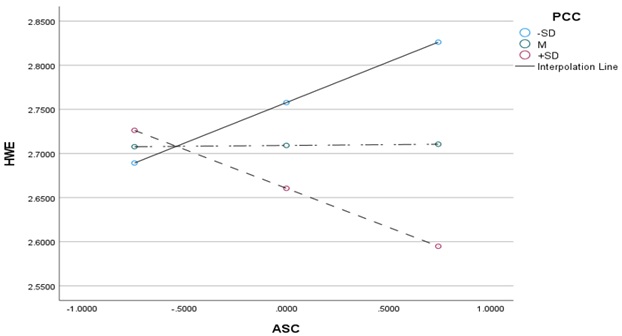
As shown by the Johnson–Neyman technique (Hayes, 2022), perceived teacher psychological control moderated the direct effect of perceived teacher autonomy support on students’ homework effort when the score of perceived psychological control reached a critical value of 1.55. This result suggests that when students perceived teachers’ psychological control as lower than this value, the effect was non-significant. Conversely, when the perceived value of psychological control exceeded the critical value, the effect was significant. Given that the interaction slope was negative, the moderating effect can be interpreted as follows: the association between perceived teacher autonomy support and students’ homework effort was not significant among students who perceived lower levels of teacher psychological control (< 1.55) and negative and significant among those who perceived higher levels (> 1.55). Detailed results of the simple slope analysis are presented in Table 2.

The interaction described above can be more clearly appreciated when plotted across levels of perceived psychological control, as shown in Figure 3.

Discussion
Homework plays a significant role in students' academic and personal development, provided it is completed with the appropriate effort of the students, as long as it is complete. However, many students struggle to maintain the motivation required to invest sufficient effort in homework (Rosário et al., 2018; Valle et al., 2019). Although prior research has found that students’ perception of teachers’ autonomy-supportive practices encourages greater effort in homework (Feng et al., 2019; Xu, 2016; Xu et al., 2021), the mechanism underlying this relationship remains unclear. The present study examined the role of students’ perception of autonomy-supportive practices in fostering their autonomous motivation and effort in homework.
Building on the work of scholars such as Amoura et al. (2015) and Grolnick and Lerner (2023), who argue that perceived autonomy-supportive and psychologically-controlling practices are distinct constructs and emphasize the importance of examining their interaction, this study examined the moderating role of perceived psychologically controlling practices in the relationships among students’ perceived autonomy support, autonomous motivation, and homework effort. We hypothesized that students’ perceptions of autonomy-supportive teachers would foster homework effort by enhancing autonomous motivation for completing homework. Moreover, we expected that perceived psychologically-controlling practices would moderate the associations between perceived autonomy, autonomous motivation, and homework effort.
The results reveal a direct link between perceived teacher autonomy support and the study variables, providing evidence to validate our hypothesis. As expected, perceived teacher autonomy support had a positive correlation with students’ autonomous motivation and effort in homework. The results support that perceived teacher autonomy influences students' effort in homework via autonomous motivation for homework. It is important to note that perceived psychologically controlling practices moderate the link between perceived teacher autonomy support and homework effort but not the relationship between these practices and autonomous motivation.
The importance of considering perceived autonomy support in homework effort
Despite being underutilized, the study found a positive relationship between perceived teachers' autonomy support and students' autonomous motivation for homework. This finding aligns with previous research indicating that perceived autonomy support is positively linked with the development of psychological resources, such as autonomous motivation (Hagger et al., 2015; Ljubin-Golub et al., 2020). Our results also indicate that students’ perception that teachers promoting choice, decision-making, providing explanations, and allowing students to solve problems can increase their autonomous motivation in learning (Haerens et al., 2015; Hagger et al., 2015; Mouratidis et al., 2017). Furthermore, in line with the literature (Feng et al., 2019; Xu, 2016; Xu et al., 2021), the results of this study suggest that perceived autonomy-supportive practices have a positive link with homework effort. These findings highlight the significance of perceived autonomy-supportive practices in fostering students’ psychological resources and behaviors related to academic activities that extend beyond the school environment.
Link between autonomous motivation and homework effort
The research findings further support that autonomous motivation is positively associated with homework effort, aligning with previous research (Feng et al., 2019). As shown in previous studies, our results suggest that autonomously motivated students are driven by personal curiosity, interest, and a sense of self-choice, which can lead to increased effort in academic activities (Hagger et al., 2016; Núñez et al., 2019). In sum, the study findings imply that autonomous motivation promotes homework effort by aligning students' personal interests, values, and satisfaction with the learning goals achieved through homework.
Moderate role of teacher psychological controlling practices
Our research found that the use of psychologically-controlling practices by teachers does not moderate the relationship between their other autonomy-supportive practices and students' autonomous motivation for effort in homework. This finding confirms the claim that the level of teacher autonomy support is a critical factor in fostering autonomous motivation that is not affected by the use of psychologically-controlling practices by teachers. Although further studies are necessary to understand the mechanism that explains this finding, future studies should explore students' appraisal of these practices. When students feel that their autonomy is generally supported, they may view controlling practices as simply a means for the teacher to maintain order rather than an inherent aspect of the teacher's approach.
Interestingly, the findings indicate a moderate effect of psychologically controlling teachers' practices on the relationships between teachers' autonomy-supportive practices and students' effort in homework. That is, teachers' use of low levels of psychological controlling practices is necessary for their autonomy-supportive practices to have a positive link with homework effort. It is essential to note that students' perceptions of medium to high levels of psychologically-controlling practices may hinder the positive effect of autonomy-supportive practices on homework effort, which warrants further attention.
Conclusions
These results suggest that autonomy support and psychological control are distinct constructs that do not represent opposite ends of a single continuum (Gong & Wang, 2021; Kunz & Grych, 2013; McCurdy et al., 2020; Skinner et al., 2005). In line with previous research, the study suggests that the lack of autonomy support does not necessarily indicate the presence of controlling teacher practices, and vice versa (Haerens et al., 2015; Haerens et al., 2016). The findings of the study emphasize the value of examining the interaction between the teacher’s socialization practices (Amorose & Anderson-Butcher, 2015; Gong & Wang, 2021; Grolnick & Lerner, 2023) in order to attain a deeper comprehension of the teacher’s influence on the homework performance of their students. According to SDT, our results confirmed that autonomy-supportive teachers contribute to developing psychological resources and fostering positive academic behaviors when using low-frequency psychologically controlling practices.
The significance of this study rests in its potential to influence the education of primary and secondary students. The findings indicate the necessity of informing educational authorities about the importance of equipping teachers with the skills to employ autonomy-supportive practices and refrain from using psychologically-controlling practices to enhance students' homework performance. Moreover, the study underscores the importance of teachers encouraging students' autonomous motivation for their homework.
Limitations
The current study aims to enrich the existing knowledge base regarding the connections among teaching practices, student motivation, and homework effort in primary and secondary school students. However, it is crucial to acknowledge certain limitations of this study. A non-experimental mediation model was used, which precludes the determination of causal relationships between the variables examined and the possibility of alternative mediators or moderators, as well as the potential that alternative models may also fit the data. Thus, future research could benefit from employing longitudinal or experimental designs to more effectively explore causal mechanisms that influence student homework efforts. Moreover, it is worth noting that the measurements used in this study were derived from self-reported responses by the students. Thus, it is recommended that future research incorporate additional methods, such as observations or interviews, and consider the perspectives of teachers to provide a more comprehensive examination of the impact of teaching practices on homework effort. Finally, another limitation concerns the construct's generality. The study focused on students' perceptions of autonomy support and control in homework in general. These constructs could be measured more specifically by focusing on homework related to a particular subject area (e.g., mathematics or a second language). Future research should adopt domain-specific measures to capture potential variations in students' perception of teachers' practices and motivational processes across domains.
References
Amorose, A. J., & Anderson-Butcher, D. (2015). Exploring the independent and interactive effects of autonomy-supportive and controlling coaching behaviors on adolescent athletes’ motivation for sport. Sport, Exercise, and Performance Psychology, 4(3), 206–218. https://doi.org/10.1037/spy0000038
Amoura, C., Berjot, S., Gillet, N., Caruana, S., Cohen, J., & Finez, L. (2015). Autonomy-supportive and controlling styles of teaching. Swiss Journal of Psychology, 74(3), 141–158. https://doi.org/10.1024/1421-0185/a000156
Awang-Hashim, R., Thaliah, R., & Kaur, A. (2017). A cultural insight into the development of teacher autonomy support scale: A self-determination theory perspective. Journal for Multicultural Education, 11(4), 287–305. https://doi.org/10.1108/JME-09-2016-0050
Banerjee, R., & Halder, S. (2021). Effect of teacher and parent autonomy support on academic motivation: A central focus of self-determination theory. World Futures, 77(6), 452–480. https://doi.org/10.1080/02604027.2021.1959253
Benita, M., & Matos, L. (2021). Internalization of mastery goals: The differential effect of teachers’ autonomy support and control. Frontiers in Psychology, 11, e599303. https://doi.org/10.3389/fpsyg.2020.599303
Bradshaw, E. L., Duineveld, J. J., Conigrave, J. H., Steward, B. A., Ferber, K. A., Joussemet, M., Parker, P. D., & Ryan, R. M. (2025). Disentangling autonomy-supportive and psychologically controlling parenting: A meta-analysis of self-determination theory’s dual process model across cultures. American Psychologist, 80(6), 879–895. https://doi.org/10.1037/amp0001389
Cheon, S. H., Reeve, J., & Vansteenkiste, M. (2020). When teachers learn how to provide classroom structure in an autonomy-supportive way: Benefits to teachers and their students. Teaching and Teacher Education, 90, e103004. https://doi.org/10.1016/j.tate.2019.103004
Cooper, H., Jackson, K., Nye, B., & Lindsay, J. J. (2001). A model of homework’s influence on the performance evaluations of elementary school students. The Journal of Experimental Education, 69(2), 181–199. https://doi.org/10.1080/00220970109600655
Cunha, J., Rosário, P., Núñez, J. C., Vallejo, G., Martins, J., & Högemann, J. (2019). Does teacher homework feedback matter to 6th graders’ school engagement?: A mixed methods study. Metacognition and Learning, 14(2), 89–129. https://doi.org/10.1007/s11409-019-09200-z
Datu, J. A. D., Yuen, M., & Chen, G. (2018). The triarchic model of grit is linked to academic success and well-being among Filipino high school students. School Psychology Quarterly, 33(3), 428–438. https://doi.org/10.1037/spq0000234
Deci, E. L., & Ryan, R. M. (2008). Self-determination theory: A macrotheory of human motivation, development, and health. Canadian Psychology / Psychologie canadienne, 49 (3), 182–185. https://doi.org/10.1037/a0012801
Domen, J., Hornstra, L., Weijers, D., van der Veen, I., & Peetsma, T. (2020). Differentiated need support by teachers: Student-specific provision of autonomy and structure and relations with student motivation. British Journal of Educational Psychology, 90(2), 403–423. https://doi.org/10.1111/bjep.12302
Donald, J. N., Bradshaw, E. L., Conigrave, J. H., Parker, P. D., Byatt, L. L., Noetel, M., & Ryan, R. M. (2021). Paths to the light and dark sides of human nature: A meta-analytic review of the prosocial benefits of autonomy and the antisocial costs of control. Psychological Bulletin, 147(9), 921–946. https://doi.org/10.1037/bul0000338
Fan, H., Xu, J., Cai, Z., He, J., & Fan, X. (2017). Homework and students’ achievement in math and science: A 30-year meta-analysis, 1986–2015. Educational Research Review, 20, 35–54. https://doi.org/10.1016/j.edurev.2016.11.003
Feng, X., Xie, K., Gong, S., Gao, L., & Cao, Y. (2019). Effects of parental autonomy support and teacher support on middle school students’ homework effort: Homework autonomous motivation as mediator. Frontiers in Psychology, 10, e612. https://doi.org/10.3389/fpsyg.2019.00612
Flunger, B., Trautwein, U., Nagengast, B., Lüdtke, O., Niggli, A., & Schnyder, I. (2017). A person-centered approach to homework behavior: Students’ characteristics predict their homework learning type. Contemporary Educational Psychology, 48, 1–15. https://doi.org/10.1016/j.cedpsych.2016.07.002
Funder, D. C., & Ozer, D. J. (2019). Evaluating effect size in psychological research: Sense and nonsense. Advances in Methods and Practices in Psychological Science, 2(2), 156–168. https://doi.org/10.1177/2515245919847202
Gershenson, S., & Holt, S. B. (2015). Gender gaps in high school students’ homework time. Educational Researcher, 44(8), 432–441. https://doi.org/10.3102/0013189X15616123
Göllner, R., Damian, R. I., Rose, N., Spengler, M., Trautwein, U., Nagengast, B., & Roberts, B. W. (2017). Is doing your homework associated with becoming more conscientious? Journal of Research in Personality, 71, 1–12. https://doi.org/10.1016/j.jrp.2017.08.007
Gong, X., & Wang, C. (2021). Interactive effects of parental psychological control and autonomy support on emerging adults’ emotion regulation and self-esteem. Current Psychology, 42(19), 16111–16120. https://doi.org/10.1007/s12144-021-01483-3
Grolnick, W. S., & Lerner, R. E. (2023). How parental support, structure, and involvement help children flourish: Considering interactions, context, and diversity. In R. M. Ryan (Ed.), The Oxford handbook of self-determination theory (pp. 491–508). Oxford University Press. https://doi.org/10.1093/oxfordhb/9780197600047.013.26
Haerens, L., Aelterman, N., Vansteenkiste, M., Soenens, B., & Van Petegem, S. (2015). Do perceived autonomy-supportive and controlling teaching relate to physical education students’ motivational experiences through unique pathways? Distinguishing between the bright and dark side of motivation. Psychology of Sport and Exercise, 16(3), 26–36. https://doi.org/10.1016/j.psychsport.2014.08.013
Haerens, L., Vansteenkiste, M., Aelterman, N., & Van den Berghe, L. (2016). Toward a systematic study of the dark side of student motivation: antecedents and consequences of teachers’ controlling behaviors. In W. C. Liu, J. Chee Keng Wang, & R. M. Ryan (Eds.), Building autonomous learners: Perspectives from research and practice using self-determination theory (pp. 59-81). Springer. https://doi.org/10.1007/978-981-287-630-0_4
Hagger, M. S., Sultan, S., Hardcastle, S. J., & Chatzisarantis, N. L. D. (2015). Perceived autonomy support and autonomous motivation toward mathematics activities in educational and out-of-school contexts is related to mathematics homework behavior and attainment. Contemporary Educational Psychology, 41, 111–123. https://doi.org/10.1016/j.cedpsych.2014.12.002
Hagger, M. S., Sultan, S., Hardcastle, S. J., Reeve, J., Patall, E. A., Fraser, B., Hamilton, K., & Chatzisarantis, N. L. D. (2016). Applying the integrated trans-contextual model to mathematics activities in the classroom and homework behavior and attainment. Learning and Individual Differences, 45, 166–175. https://doi.org/10.1016/j.lindif.2015.11.017
Hayes, A. F. (2022). Introduction to mediation, moderation, and conditional process analysis: A regression-based analysis (3er ed.). The Guilford Press.
Howard, J. L., Bureau, J. S., Guay, F., Chong, J. X. Y., & Ryan, R. M. (2021). Student motivation and associated outcomes: A meta-analysis from self-determination theory. Perspectives on Psychological Science, 16(6), 1300–1323. https://doi.org/10.1177/1745691620966789
Jang, H., Kim, E. J., & Reeve, J. (2016). Why students become more engagement or more disengaged during the semester: A self-determination theory dual-process model. Learning and Instruction, 43, 27–38. https://doi.org/10.1016/j.learninstruc.2016.01.002
Kackar, H. Z., Shumow, L., Schmidt, J. A., & Grzetich, J. (2011). Age and gender differences in adolescents' homework experiences. Journal of Applied Developmental Psychology, 32(2), 70–77. https://doi.org/10.1016/j.appdev.2010.12.005
Katz, I., Kaplan, A., & Buzukashvily, T. (2011). The role of parents' motivation in students' autonomous motivation for doing homework. Learning and Individual Differences, 21(4), 376–386. https://doi.org/10.1016/j.lindif.2011.04.001
Katz, I., Kaplan, A., & Gueta, G. (2009). Students’ needs, teachers’ support, and motivation for doing homework: A cross-sectional study. The Journal of Experimental Education, 78(2), 246–267. https://doi.org/10.1080/00220970903292868
Kunz, J. H., & Grych, J. H. (2013). Parental psychological control and autonomy granting: Distinctions and associations with child and family functioning. Parenting: Science and Practice, 13(2), 77–94. https://doi.org/10.1080/15295192.2012.709147
Little, T. D., Bovaird, J. A., & Widaman, K. F. (2006). On the merits of orthogonalizing powered and product terms: Implications for modeling interactions among latent variables. Structural Equation Modeling: A Multidisciplinary Journal, 13(4), 497–519. https://doi.org/10.1207/s15328007sem1304_1
Liu, J. D., & Chung, P. K. (2014). Development and initial validation of the Psychological Needs Satisfaction Scale in physical education. Measurement in Physical Education and Exercise Science, 18(2), 101–122. https://doi.org/10.1080/1091367x.2013.872106
Ljubin-Golub, T., Rijavec, M., & Olčar, D. (2020). Student flow and burnout: The role of teacher autonomy support and student autonomous motivation. Psychological Studies, 65(2), 145–156. https://doi.org/10.1007/s12646-019-00539-6
McCurdy, A. L., Williams, K. N., Lee, G. Y., & Benito-Gomez, M., Fletcher, A. C., & Fletcher, A. C. (2020). Measurement of parental autonomy support: A review of theoretical concerns and developmental considerations. Journal of Family Theory & Review, 12(3), 382–397. https://doi.org/10.1111/jftr.12389
Mouratidis, A., Michou, A., Aelterman, N., Haerens, L., & Vansteenkiste, M. (2017). Begin-of-school-year perceived autonomy-support and structure as predictors of end-of-school-year study efforts and procrastination: The mediating role of autonomous and controlled motivation. Educational Psychology, 38(4), 435–450. https://doi.org/10.1080/01443410.2017.1402863
Núñez, J. C., Regueiro, B., Suárez, N., Piñeiro, I., Rodicio, M. L., & Valle, A. (2019). Student perception of teacher and parent involvement in homework and student engagement: The mediating role of motivation. Frontiers in Psychology, 10, e1384. https://doi.org/10.3389/fpsyg.2019.01384
Núñez, J. C., Suárez, N., Rosário, P., Vallejo, G., Valle, A., & Epstein, J. L. (2015). Relationships between perceived parental involvement in homework, student homework behaviors, and academic achievement: Differences among elementary, junior high, and high school students. Metacognition and Learning, 10(3), 375–406. https://doi.org/10.1007/s11409-015-9135-5
Núñez, J. L., León, J., Grijalvo, F., & Albo, J. M. (2012). Measuring autonomy support in university students: The Spanish version of the Learning Climate Questionnaire. The Spanish Journal of Psychology, 15(3), 1466–1472. https://doi.org/10.5209/rev_SJOP.2012.v15.n3.39430
Özcan, Z. Ç. (2015). The relationship between mathematical problem-solving skills and self-regulated learning through homework behaviours, motivation, and metacognition. International Journal of Mathematical Education in Science and Technology, 47(3), 408–420. https://doi.org/10.1080/0020739X.2015.1080313
Ozyildirim, G. (2022). Time spent on homework and academic achievement: A meta-analysis study related to results of TIMSS. Psicología Educativa, 28(1), 13–21. https://doi.org/10.5093/psed2021a30
Patall, E. A., Pituch, K. A., Steingut, R. R., Vasquez, A. C., Yates, N., & Kennedy, A. A. U. (2019). Agency and high school science students’ motivation, engagement, and classroom support experiences. Journal of Applied Developmental Psychology, 62, 77–92. https://doi.org/10.1016/j.appdev.2019.01.004
Podsakoff, P. M., Mackenzie, S. B., Lee J.-Y, & Podsakoff, N. P. (2003). Common method biases in behavioral research: A critical review of the literature and recommended remedies. Journal of Applied Psychology, 88(5), 879–903. https://doi.org/10.1037/0021-9010.88.5.879
Reeve, J., & Cheon, S. H. (2021). Autonomy-supportive teaching: Its malleability, benefits, and potential to improve educational practice. Educational Psychologist, 56(1), 54–77. https://doi.org/10.1080/00461520.2020.1862657
Rosário, P., Núñez, J. C., Vallejo, G., Nunes, T., Cunha, J., Fuentes, S., & Valle, A. (2018). Homework purposes, homework behaviors, and academic achievement. Examining the mediating role of students’ perceived homework quality. Contemporary Educational Psychology, 53, 168–180. https://doi.org/10.1016/j.cedpsych.2018.04.001
Ryan, R. M., & Deci, E. L. (2017). Self-determination theory: Basic psychological needs in motivation, development, and wellness. The Guilford Press. https://doi.org/10.1521/978.14625/28806
Ryan, R. M., Reeve, J., Kaplan, H., Matos, L., & Cheon, S. H. (2023). Education as flourishing: Self-determination theory in schools as they are and as they might be. In R. M. Ryan (Ed.), The Oxford handbook of self-determination theory (pp. 591–618). Oxford University Press. https://doi.org/10.1093/oxfordhb/9780197600047.013.60
Skinner, E. A., Pitzer, J. R., & Steele, J. S. (2016). Can student engagement serve as a motivational resource for academic coping, persistence, and learning during late elementary and early middle school? Developmental Psychology, 52(12), 2099–2117. https://doi.org/10.1037/dev0000232
Skinner, E., Johnson, S., & Snyder, T. (2005). Six dimensions of parenting: A motivational model. Parenting: Science and Practice, 5(2), 175–235. https://doi.org/10.1207/s15327922par0502_3
Soenens, B., Sierens, E., Vansteenkiste, M., Dochy, F., & Goossens, L. (2012). Psychologically controlling teaching: Examining outcomes, antecedents, and mediators. Journal of Educational Psychology, 104(1), 108–120. https://doi.org/10.1037/a0025742
Suárez, N., Regueiro, B., Estévez, I., Ferradás, M. M., Guisande, M. A., & Rodriguez, S. (2019). Individual precursors of student homework behavioral engagement: The role of intrinsic motivation, perceived homework utility and homework attitude. Frontiers in Psychology, 10, e941. https://doi.org/10.3389/fpsyg.2019.00941
Trautwein, U., Lüdtke, O., Schnyder, I., & Niggli, A. (2006). Predicting homework effort: Support for a domain-specific, multilevel homework model. Journal of Educational Psychology, 98(2), 438–456. https://doi.org/10.1037/0022-0663.98.2.438
Valle, A., Piñeiro, I., Rodríguez, S., Regueiro, B., Freire, C., & Rosário, P. (2019). Time spent and time management in homework in elementary school students: A person-centered approach. Psicothema, 31(4), 422–428. https://doi.org/10.7334/psicothema2019.191
van der Kaap-Deeder, J., Vansteenkiste, M., Soenens, B., & Mabbe, E. (2017). Children’s daily well-being: The role of mothers’, teachers’, and siblings’ autonomy support and psychological control. Developmental Psychology, 53(2), 237–251. https://doi.org/10.1037/dev0000218
Vansteenkiste, M., & Ryan, R. M. (2013). On psychological growth and vulnerability: Basic psychological need satisfaction and need frustration as a unifying principle. Journal of Psychotherapy Integration, 23(3), 263–280. https://doi.org/10.1037/a0032359
Wang, M., & Hu, J. (2022). Perceived teacher autonomy support for adolescents’ reading achievement: The mediation roles of control-value appraisal and emotions. Frontiers in Psychology, 13, 3959461. https://doi.org/10.3389/fpsyg.2022.959461
Williams, L. J., & McGonagle, A. K. (2016). Four research design and comprehensive analysis strategy for investigating common method variance with self-report measures using latent variables. Journal of Business Psychology, 31(3), 339–359. https://doi.org/10.1007/s10869-015-9422-9
Xu, J. (2016). A study of the validity and reliability of the Teacher Homework Involvement Scale: A psychometric evaluation. Measurement, 93, 102–107. https://doi.org/10.1016/j.measurement.2016.07.012
Xu, J. (2023). Student-perceived parental help with homework: Identifying student profiles and their relations with homework effort, procrastination, and achievement. Learning and Individual Differences, 104, e102299. https://doi.org/10.1016/j.lindif.2023.102299
Xu, J. (2024). Student-perceived teacher and parent homework involvement: Exploring latent profiles and links to homework behavior and achievement. Learning and Individual Differences, 109, e102403. https://doi.org/10.1016/j.lindif.2023.102403
Xu, J., & Corno, L. (2022). Extending a model of homework: A multilevel analysis with Chinese middle school students. Metacognition and Learning, 17(2), 531–563. https://doi.org/10.1007/s11409-022-09296-w
Xu, J., Du, J., Cunha, J., & Rosário, P. (2021). Student perceptions of homework quality, autonomy support, effort, and math achievement: Testing models of reciprocal effects. Teaching and Teacher Education, 108, e103508. https://doi.org/10.1016/j.tate.2021.103508
Xu, J., Du, J., Wu, S., Ripple, H., & Cosgriff, A. (2018). Reciprocal effects among parental homework support, effort, and achievement? An empirical investigation. Frontiers in Psychology, 9, e2334. https://doi.org/10.3389/fpsyg.2018.02334
Yang, F., & Tu, M. (2019). Self-regulation of homework behaviour: Relating grade, gender, and achievement to homework management. Educational Psychology, 40(4), 392–408. https://doi.org/10.1080/01443410.2019.1674784
Notes
*
Artículo de investigación
El estudio fue financiado por
el Programa de Fortalecimiento a la Investigación del Instituto Tecnológico de
Sonora (PROFAPI 2025_019)
Author notes
a Correspondence author. Email: angel.valdes@itson.edu.mx
Additional information
How to cite: Valdés-Cuervo, A. A., Velderrain-Valenzuela,
M., Grijalva-Quiñonez, C. S., Morales-Álvarez, A., & Parra-Pérez, L. G.
(2025). Teachers’ autonomy support and homework effort: A
moderated mediation model of psychological control and autonomous motivation. Universitas Psychologica, 24,
1-15. https://doi.org/10.11144/Javeriana.upsy24.tash