


APA
ISO 690-2
Harvard
Haga clic en un formato de citación
Understanding Narcissistic Personality Traits Through Existential Theory: Insight, Meaning in Life and Existential Anxiety *
Rasgos narcisistas desde la teoría existencial: Introspección, sentido de la vida y ansiedad existencial
Furkan Onur Eken  , Muhammet Enes Kaya
Understanding Narcissistic Personality Traits Through Existential Theory: Insight, Meaning in Life and Existential Anxiety *
Universitas Psychologica, vol. 24, 2025
Pontificia Universidad Javeriana
Furkan Onur Eken a f.onureken@gmail.com
Beykent University, Turquía
Muhammet Enes Kaya
Beykent University, Turquía
Received: 26 september 2025
Accepted: 10 november 2025
Abstract: Existential theory posits that the purpose and meaning of life are unique to the individual and considers humans as phenomenological beings. Insight is crucial for individuals to find purpose and meaning in life and to achieve self-actualization through existential peace and inner comfort. Low insight can lead to difficulties in finding purpose and meaning in life, which can lead to numerous existential problems, particularly existential anxiety. Existential problems are known to be associated with various forms of psychopathology. In this context, the study aimed to investigate the extent to which narcissistic personality traits are shaped by insight, meaning in life, and existential anxiety. The study group consisted of 385 constructs; 37.4 % (144) were male and 62.6 % (241) were female. The Insight Scale, the Meaning in Life Scale, the Existential Anxiety Scale, and the Narcissism subscale of the Dark Triad Scale were used in the study. Analyses were conducted using a serial mediation model using the Process Macro 4.2 (Hayes, 2017) plugin installed in IBM SPSS [Version 25.0] (IBM Corp., 2017). Findings indicated that meaning in life and existential anxiety played a mediating role in the relationship between insight and narcissistic personality traits.
Keywords:insight, meaning in life, existential anxiety, narcissistic personality traits, existential theory.
Resumen: La teoría existencial postula que el propósito y el significado de la vida son únicos para cada individuo y considera a los humanos como seres fenomenológicos. La introspección es crucial para que las personas encuentren propósito y significado en la vida y logren la autorrealización a través de la paz existencial y el bienestar interior. Una baja introspección puede llevar a dificultades para encontrar propósito y significado en la vida, lo que puede conducir a numerosos problemas existenciales, particularmente ansiedad existencial. Se sabe que los problemas existenciales están asociados con varias formas de psicopatología. En este contexto, el estudio tuvo como objetivo investigar hasta qué punto los rasgos de personalidad narcisista están moldeados por la introspección, el significado en la vida y la ansiedad existencial. El grupo de estudio consistió en 385 constructos; 37.4 % (144) eran hombres y 62.6 % (241) eran mujeres. En el estudio se utilizaron la Escala de Introspección, la Escala de Significado en la Vida, la Escala de Ansiedad Existencial y la subescala de Narcisismo de la Escala de la Tríada Oscura. Los análisis se realizaron utilizando un modelo de mediación serial utilizando el complemento Process Macro 4.2 (Hayes, 2017) instalado en IBM SPSS [Versión 25.0] (IBM Corp., 2017). Los hallazgos indicaron que el significado de la vida y la ansiedad existencial desempeñaron un papel mediador en la relación entre la introspección y los rasgos de personalidad narcisista.
Palabras clave: introspección, sentido de la vida, ansiedad existencial, rasgos de personalidad narcisista, teoría existencial.
Existence is defined as the ability to spiritually transcend one’s own physical and spiritual boundaries (Frankl, 1958). According to existential theory, meaning is never truly lacking. Everyone has a unique task to fulfill in life. As a result, humans should ask not what the meaning of life is, but what the meaning of their own life is (Frankl, 1959; Frankl 1967). Existential theory argues that human existence and the meaning attributed to existence are unique to the individual and sees humans as phenomenological beings (May & Yalom, 2005; Yalom, 1980). In this context, meaning emerges when people confront both the challenges they face in the world and their own existence (Längle, 2003). However, the meaning and purpose of life cannot be prescribed like a drug. An individual can only reach the purpose of life through an existential analysis process under the responsibility of an expert (Frankl, 1967). Yalom (1980) emphasizes that the sources of meaning that people draw on in their lives change throughout life and therefore should be addressed with a developmental approach. In this context, even the negative aspects of human existence, such as pain, guilt, and death, can be transformed into positive sources of meaning with the right approach (Frankl, 1967). In this respect, considering that the meaning of life is closely related to existential motivation in one sense, existential motivation is also considered as a basic factor in the contexts where the meaning of life is investigated (Längle, 2003).
Insight, meaning in life and existential anxiety can be considered the most important concepts at the core of existential theory. In addition to the positive effects of finding meaning in life, situations where this meaning cannot be found or where there is meaninglessness are intertwined with a number of anxiety areas such as death, identity, loneliness, freedom, and vulnerability, which is expressed as an inclusive expression with the concept of existential anxiety (Reed et al., 2021; van Bruggen et al., 2014). Frankl (1984) believes that existential problems are not psychopathological. He says that people's anxiety and hopelessness about the meaning and worth of their own lives should be evaluated as an existential issue, not as a type of mental illness. Although Yalom (1980) does not consider existential problems as a psychopathology, he supports this view by stating that lack of meaning is related to psychopathology. Changes in the meaning that a person attributes to their life bring about positive and negative changes in psychological functioning. For this reason, meaning in life can function in a structure that affects psychological well-being in different ways (Zika & Chamberlain, 1992). In this context, existential anxiety can be said to stem not only from a lack of search for meaning but also from an individual's confrontation with fundamental fears that threaten their very existence. Indeed, narcissistic defenses, a mechanism developed against this existential anxiety, serve as armor against the individual's fear of worthlessness, lovelessness, and annihilation (Kernberg, 1975). To avoid the feelings of emptiness and meaninglessness created by existential anxiety, the individual exalts the self, and thus narcissistic traits emerges as a defensive form of coping with the vulnerability engendered by existential anxiety (Kohut, 1971).
While previous studies have addressed personality traits within the context of existential anxiety, as in evaluations of the meaning of life, and explored the relationships between general personality traits and levels of existential anxiety (Demir & İkizer, 2020; Shumaker et al., 2017), moving beyond a theoretical framework to consider the concepts of existential anxiety and meaning in life as psychological representations of subjective experiences rather than a philosophical framework, and to evaluate this relationship holistically with narcissistic personality traits based on the cognitive, emotional and behavioural level, allows for an epistemologically sound understanding. In this study, the concepts of insight, the meaning of life, and existential anxiety, which are essentially phenomenological and philosophical in nature, are considered as implicit constructs at the core of psychology. Although these psychological constructs are not directly observable or measurable, they can be measured indirectly by examining individuals' cognitive, emotional, and behavioral responses (Borsboom et al., 2004; Cronbach & Meehl, 1955)
Insight is considered a holistic structure that includes cognitive, emotional, and behavioral processes, as well as being an existential and phenomenological structure (Akdoğan & Türküm, 2018). In this context, insight is a thinking and living process that is affected by many internal and external variables (Markova & Berrios, 1992). Existential theory, emphasizes insight as an important precursor to an individual's discovery of the meaning of life (Frankl, 1959; Yalom, 1980). However, within the framework of findings that meaning in life reduces existential anxiety (Kesebir & Pyszczynski, 2014; Pellens et al., 2022), the variable of meaning in life is prioritized over existential anxiety. Kohut (1971) and Kernberg (1975) argue that narcissistic personality traits counter existential feelings of insecurity and meaninglessness. Therefore, existential factors are considered to be important variables in the formation and development of narcissistic personality structures. Within the framework of these theoretical approaches, the research model was constructed with the serial mediation model in a relational process in which insight, meaning of life, existential anxiety and narcissistic personality traits follow each other. In this context, when considered from the perspective of existential theory, understanding the predictive effect of insight on narcissistic personality traits through the meaning of life and existential anxiety is expected to enrich the literature on the existential approach by proposing a testable model.
Method
Research model
The mediation relationships were examined with the serial multiple mediator variable model. Within the scope of this model, total effects, direct effects and indirect effects were evaluated. In this study, the concept of prediction was used in a statistical sense, and no direct inference was made regarding the existence of causal relationships between variables. The purpose of a study using this model is to investigate the direct and indirect effects of the independent variable on the dependent variable and to examine how the independent variable interacts with the first mediator variable, which in turn interacts with the second mediator variable and thus how it ultimately relates to the dependent variable (Hayes, 2017).
Sample group
The sample of the study consisted of 385 young adult participants. The average age of the participants is 23.41. 37.4 % (144) of the participants were male, 62.6 % (241) were female. 10.1 % (39) had an associate degree, 84.4 % (325) had an undergraduate degree, and 5.5 % (21) had a postgraduate degree. Convenient sampling method was used in the study. Participants in the study were young adults aged 18 and over who volunteered to participate. The sample size in the study was determined according to the sample size calculations of Yazıcıoğlu and Erdoğan (2004). In addition, in order to determine the power of the study, the post hoc power analysis conducted based on effect sizes, margin of error (α = 0.05) and sample size (N = 385) for correlation and regression analyses showed that the statistical power (1 – β > 0.80) was sufficient for both tests (Faul et al., 2007).
Measures
Insight Scale
The Insight Scale was developed by Akdoğan and Türküm (2018) in a sample of young adult university students to determine the insight levels of individuals (Mage = 20-23). The scale contains a total of 20 items. These items are located under three sub-dimensions: Holistic View, Self-Acceptance and Self-Understanding. The scale, which was developed in the 5-point Likert type, ranging from 1 (never) to 5 (always). The results of the exploratory factor analysis showed that 45.24 % of the total variance was explained. The confirmatory factor analysis revealed goodness-of-fit coefficients as χ2 = 294.34, χ2 /df = 1.77, RMSEA = 0.053, CFI = 0.90, and GFI = 0.90. Cronbach Alpha reliability value of the scale was calculated as 0.84.
The Meaning of Life Scale
The Meaning of Life Scale is a measurement tool developed by Steger et al. (2006). The scale consists of two sub-dimensions, namely the existing meaning and the meaning that is being tried to be found, and there are a total of 10 items in these sub-dimensions. The scale, scored between 1 and 7, was prepared in a 7-point Likert structure (1 = strongly disagree, 7 = strongly agree). The scale was adapted to Turkish by Demirdağ and Kalafat (2015) in a sample of 322 university students. In the study, exploratory factor analysis yielded two dimensions that accounted for 68.2 % of the variance. The goodness-of-fit coefficients obtained in the confirmatory factor analysis were calculated as RMSEA = 0.068, NFI = 0.93, CFI = 0.95, GFI = 0.93, AGFI = 0.89, and RFI = 0.92. Reliability values for the entire scale were calculated between 0.86 and 0.91 for different groups.
Existential Anxiety Scale
The Existential Anxiety Scale was developed by Yıkılmaz (2016) in a sample of 781 undergraduate students with a mean age of 21.36. There are 25 items in total in the scale ranging from 1 (does not reflect me at all) to 5 (completely reflects me). There are four different sub-dimensions in the scale: meaninglessness anxiety, death, isolation and freedom anxiety. In the study, it was determined that four sub-dimensions explained 32.75 % of the variance. As a result of confirmatory factor analysis, goodness of fit coefficients were calculated as χ2 = 675.58, χ2 /df = 2.49, RMSEA = 0.08, NFI = 0.86, RMR = 0.08, CFI = 0.91, NNFI = 0.90, GFI = 0.82, AGFI = 0.83 and SRMR = 0.08. The reliability coefficient of the scale was determined as 0.84.
Short Dark Triad Scale
The Short Dark Triad Scale is a measurement tool developed by Jones and Paulhus (2013) to measure the personality traits of machiavellianism, psychopathy, and narcissism. The narcissism subscale was used in this study. The subscale consists of 9 items. scored between 1 and 5, was developed on a 5-point Likert structure (1 = strongly Disagree, 5 = strongly agree). The Turkish adaptation of the scale was conducted by Özsoy et al. (2017) with 341 participants consisting predominantly of younger adults. The result of the confirmatory factor analysis was determined as χ2 = 708.38, χ2 /df = 2.21, TLI = 0.79, CFI = 0.81, RMSEA = 0.06. The reliability coefficients of the scale were calculated as 0.70, 0.79, and 0.79 for the sub-dimensions.
Data Collection
Informed consent was obtained from all participants for inclusion in the study. Data collection was conducted both in person and online. Ethical approval for this study was obtained from the Istanbul Beykent University Publication Ethics Committee for the Social Sciences and Humanities.
Data Analysis
The distribution of the data was assessed using histograms, boxplots, z-values, and skewness and kurtosis coefficients. Accordingly, the data were organized by examining invalid responses and outliers. Relationships between variables were analyzed with Pearson correlation analysis. Before the regression analyses, the assumptions of linearity (Scatter Plot), independence of error terms (Durbin Watson), normality of residuals (Shapiro–Wilk), homogeneity of variances and multicollinearity (Tolerance and VIF) were tested (Astar & Güriş, 2019; Tabachnick & Fidell, 2018). Estimates were obtained using ordinary least squares (OLS) regression. 95 % bias-corrected bootstrap confidence intervals were calculated with 5,000 resamplings. The statistical power of the analyses was calculated with G*Power 3.1 (Faul et al., 2007). Mediation analyses were performed based on serial multiple mediation analysis (Model 6). The mediation effect was analyzed using the Process Macro 4.2 program (Hayes, 2017). The analyzes in the study were made using the IBM SPSS [Version 25.0] (IBM Corp., 2017).
Results

According to the results in Table 1, there is a significant relationship between insight and the meaning in life (r = 0.377, p < 0.01), existential anxiety (r = -0.525, p < 0.01) and narcissism (r = 0.156, p < 0.01). However, there is a significant relationship between the meaning in life and existential anxiety (r = -0.311, p < 0.01) and narcissism (r = 0.250, p < 0.01). There is a significant relationship between the existential anxiety and narcissism (r = -0.287, p < 0.01).
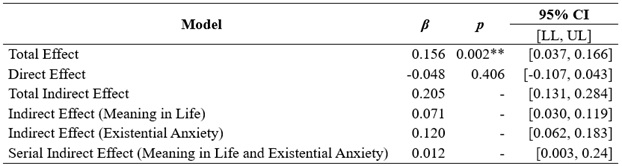
Table 2 presents the standardized regression coefficients for the direct, indirect, and total predictive effect of insight on the mediating role of meaning in life and existential anxiety in the relationship between insight and narcissistic personality traits. The regression analysis results show that the mediation model is statistically significant [F(2, 382) = 16.156, p < 0.001]. The model explains 11.2 % of the variance in the dependent variable (R² = 0.112). The effect size was calculated as f ² = 0.13, which is close to a medium level (Cohen, 1988).
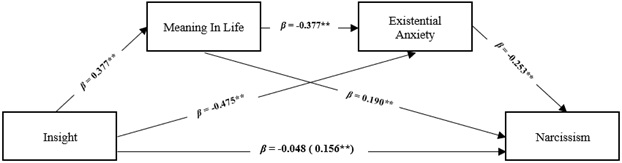
The analysis revealed that the total effect of insight on narcissism was significant (β = 0.156; [0.037: 0.166]). The direct effect of insight on narcissism (β = -0.048; [-0.107: 0.043]) were not significant. The serial mediating roles insight and meaning in life (β = 0.012; [0.003: 0.024]); the single mediating roles of meaning in life (β = 0.071; [0.030: 0.119]) and existential anxiety (β = 0.120; [0.062: 0.183]) were found to be significant in the predictive effect of insight on narcissistic personality traits.
Discussion
The research findings indicate significant relationships among the key variables of the established model. This suggests significant relationships among insight, meaning in life, existential anxiety, and narcissistic personality traits. Narcissistic personality traits are characterized by grandiosity, entitlement, beliefs about being special and unique, a lack of empathy, exploiting others, entitlement, and arrogant and brash behavior (APA, 2022). However, individuals with narcissistic personality traits have exaggerated and unrealistic positive views of themselves (Campbell & Foster, 2007). There are two main perspectives in the literature on this topic. The first, called the ignorance hypothesis, proposes that narcissistic individuals fail to recognize that they possess narcissistic personality traits and believe in the perceptions that others view them favorably, resulting in a lack of insight into their personality and reputation. The second, called the awareness hypothesis, argues that narcissists possess insight into their personality and the way they are. According to this view, these individuals recognize that they possess narcissistic traits, but this understanding is based on the perceptions of others rather than their meta-perceptions and self-perceptions (Carlson et al., 2011). Accordingly, individuals with narcissistic personality traits may engage in deceptive self-evaluations and interpret external information as positive self-perceptions (Morf & Rhodewalt, 2001; Paulhus, 1988). In fact, these individuals may believe or self-evaluate their self-awareness as a result of narcissistic tendencies, even though neither is true. At least for subclinical narcissism, there is no consensus in the literature on whether narcissistic individuals possess insight into their narcissistic personalities.While narcissistic individuals, aware of their personality traits, may define themselves as arrogant and view themselves more favorably than others (Carlson et al., 2011). Studies show that narcissistic individuals are trained to self-enhance and perceive themselves more positively (Grijalva & Zhang, 2016). It is thought that the motivation behind these individuals' narcissistic tendencies may be their assumption that narcissistic images can provide advantages in life (Hart et al., 2018). A step further, according to Carlson's (2012) study, narcissistic individuals with insight tend to evaluate their narcissistic traits as desirable on an individual level, though not socially. While they may exhibit low performance in social dimensions such as social adjustment and moral behavior, viewing themselves as intelligent, resourceful, and extroverted on an individual level may be a determining factor in maintaining and increasing their narcissistic traits (Campbell et al., 2002).
In this case, there may be a positive relationship between narcissism and insight, as individuals with narcissistic traits may tend to use these traits strategically to gain gains in life when their insight is sufficiently developed. On the other hand, although the tendency of people with narcissistic traits to see themselves positively indicates that they have insight into themselves in a sense, the fact that these evaluations are more positive than the opinions of other people or objective evaluations (Park & Colvin, 2013) suggests that this insight may be relatively limited (Carlson & DesJardins, 2015) and does not sufficiently cover reality. Although a negative relationship between insight and narcissism might be expected, the positive relationship found in the study may stem from both the advantages of daily life and a false sense of self created by unrealistic perceptions of one's thoughts, feelings, and behaviors as aware, goal-oriented, successful, competent, and powerful. Therefore, while these results suggest that narcissistic personality traits increase with increased insight, for the reasons mentioned above, they also raise the possibility that true insight may not actually exist.
According to the model established in the study, meaning in life and existential anxiety appear to mediate the relationship between insight and narcissistic personality traits. Accordingly, as insight increases, meaning in life and narcissistic personality traits increase. Conversely, as insight and meaning in life increases, existential anxiety decreases. While existential anxiety increases, narcissistic personality traits decrease. Studies on the relationship between insight and meaning in life have shown that meaning in life is higher in individuals with high insight (Newman & Nezlek, 2019), while individuals with low insight are reported to have lower motivation to seek meaning in life (Klussman et al., 2020). These findings are supported by studies showing that insight and meaning in life are related (Harrington & Loffredo, 2010; Or et al., 2013). Additionally, meaning and purpose in life are known to be an important component of psychological well-being (Dahl & Davidson, 2019). This suggests that individuals with insight possess a fundamental motivation and personal resources to mobilize to find meaning in life. Another study reported a relationship between the meaning of life and existential anxiety (Shumaker et al., 2017).In understanding the negative relationship between insight and existential anxiety, the negative relationship between meaning in life and existential anxiety (Miller & Rottinghaus, 2014) can provide an explanatory framework. Insight's ability to develop greater understanding of one's own behavior can be seen as a factor that reduces existential anxiety while increasing well-being (Czyżowska & Gurba, 2021). Accordingly, it can be assumed that in individuals with low insight, meaning in life does not develop, and a related existential anxiety is experienced, while in individuals with high insight, the acquired meaning and well-being suppress existential anxiety. According to the model in the study, narcissism is positively predicted by meaning in life and negatively predicted by existential anxiety. Studies reporting results consistent with the findings in the model suggest that narcissistic individuals may be associated with acquiring self-regarding values in the external world, taking on active roles in life with high self-esteem, and finding meaning in life (Womick et al., 2020; Zhu et al., 2021).
Although no previous studies have examined the relationship between existential anxiety and narcissistic traits, this relationship can be explained through the negative relationship between existential anxiety and meaning in life. Given that meaning in life can be a fundamental motivation for narcissism (Velji & Schermer, 2024) and that this meaning is often constructed based on extrinsic values (Abeyta et al., 2016), experiencing existential anxiety may lead to a weakening of this extrinsic motivation and a decrease in narcissistic traits. On the other hand, this negative relationship between existential anxiety and narcissistic traits can be interpreted by considering the idea that narcissistic personality traits develop as a defense pattern related to internal anxiety (Kernberg, 1975; Kohut, 1971). Thus, the active use of narcissistic defense mechanisms can be explained by the repression of existential anxiety. However, it is important to note that the narcissistic personality traits discussed in this study were assessed using a measure that does not reach the level of a psychiatric diagnosis, which contributes to a more accurate interpretation of the findings.
Conclusion
The study found that meaning in life and existential anxiety mediated the predictive effect of insight on narcissistic personality traits.. This research, which aims to shed light on the existential underpinnings of narcissistic personality traits, suggests that existential processes may be influential in narcissistic personality traits. In conclusion, the findings of this study are expected to pave the way for new theoretical and applied research on personality psychopathology and contribute to the development of existentially based therapeutic interventions.
Limitations
The study was structured within a cross-sectional approach, using a mediation model. Furthermore, the study primarily focused on young adults. Therefore, it is recommended that studies be conducted using experimental models, comparing diagnostic groups, and involving clinical samples across different age groups. Convenience sampling method was used in the study, and the use of this sampling method can be considered as a factor limiting the generalizability of the results obtained. It should be noted that the narcissistic personality traits discussed in this study were evaluated in a sample that had not reached the level of psychiatric diagnosis, contributing to a more accurate interpretation of the findings.
Theoretical and Clinical Implications
The research offers important insights into how narcissistic personality traits can be shaped through an existential perspective. In this context, the study is believed to offer significant contributions to illuminating not only the outward manifestations of narcissistic personality traits but also their internal psychological functioning through a subjective approach. The research results indicate that an existential perspective may be particularly useful in the formation, development, and treatment of narcissistic personality traits. Adopting different theoretical approaches when studying these traits may be more beneficial.
Future Directions
The positive relationship between insight and meaning in life and narcissistic personality traits, and the negative relationship with existential anxiety, are thought to be remarkable findings worth examining in depth in future studies. It is anticipated that evaluating the study in a sample diagnosed with narcissistic personality disorder will increase the clinical validity and generalizability of future studies. Although it was concluded that personality pathologies such as narcissism can be explained by existentially limited themes, it is thought that variables may have mediating and moderating effects, or that these traits may be shaped by different mechanisms. Narcissism, on the other hand, can be studied using different variables within the scope of existential theory.
References
Abeyta, A. A., Routledge, C., & Sedikides, C. (2016). Material meaning: Narcissists gain existential benefits from extrinsic goals. Social Psychological and Personality Science, 8(2), 219-228. https://doi.org/10.1177/1948550616667618
Akdoğan, R., & Türküm, A. S. (2018). Insight scale for nonclinical university students: Validity and reliability analysis. Measurement and Evaluation in Counseling and Development, 51(4), 250-262. https://doi.org/10.1080/07481756.2017.1413941
American Psychiatric Association [APA]. (2022). Diagnostic and statistical manual of mental disorders (DSM-5-TR) (5th ed.). American Psychiatric Association Publishing.
Astar, M., & Güriş, S. (2019). Statistics with SPSS in scientific research. Der Publications.
Borsboom, D., Mellenbergh, G. J., & van Heerden, J. (2004). The concept of validity. Psychological review, 111(4), 1061-1071. https://doi.org/10.1037/0033-295X.111.4.1061
Campbell, W. K., & Foster, J. D. (2007). The narcissistic self: Background, an extended agency model, and ongoing controversies. In C. Sedikides & S. J. Spencer (Eds.), The self (pp. 115–138). Psychology Press.
Campbell, W. K., Rudich, E. A., & Sedikides, C. (2002). Narcissism, self-esteem, and the positivity of self-views: Two portraits of self-love. Personality and Social Psychology Bulletin, 28(3), 358-368. https://doi.org/10.1177/0146167202286007
Carlson, E. N. (2012). Honestly arrogant or simply misunderstood? Narcissists’ awareness of their narcissism. Self and Identity, 12(3), 259–277. https://doi.org/10.1080/15298868.2012.659427
Carlson, E. N., & DesJardins, N. M. L. (2015). Do mean guys always finish first or just say that they do? Narcissists’ awareness of their social status and popularity over time. Personality and Social Psychology Bulletin, 41(7), 901-917. https://doi.org/10.1177/0146167215581712
Carlson, E. N., Vazire, S., & Oltmanns, T. F. (2011). You probably think this paper's about you: Narcissists' perceptions of their personality and reputation. Journal of Personality and Social Psychology, 101(1), 185-201. https://doi.org/10.1037/a0023781
Cohen, J. (1988). Statistical power analysis for the behavioral sciences (2nd ed.). Lawrence Erlbaum Assocıates, Publıshers.
Cronbach, L. J., & Meehl, P. E. (1955). Construct validity in psychological tests. Psychological Bulletin, 52(4), 281–302. https://doi.org/10.1037/h0040957
Czyżowska, N., & Gurba, E. (2021). Does reflection on everyday events enhance meaning in life and well-being among emerging adults? Self-efficacy as mediator between meaning in life and well-being. International Journal of Environmental Research and Public Health, 18(18), 1-13. https://doi.org/10.3390/ijerph18189714
Dahl, C. J., & Davidson, R. J. (2019). Mindfulness and the contemplative life: Pathways to connection, insight, and purpose. Current opinion in psychology, 28, 60-64. https://doi.org/10.1016/j.copsyc.2018.11.007
Demir, Ş., & İkizer, G. (2020). The relationship between existential anxiety and personality, health, and demographic characteristics. Manisa Celal Bayar University Journal of Sosyal Siciences, 18(4), 352-368. https://doi.org/10.18026/cbayarsos.648986
Demirdağ, S., & Kalafat, S. (2015). The Meaning of Life Questionnaire (MLQ): Adaptation to Turkish, validity and reliability. İnönü Üniversitesi Eğitim Fakültesi Dergisi, 16(2). https://doi.org/10.17679/iuefd.16250801
Faul, F., Erdfelder, E., Lang, A. G., & Buchner, A. (2007). G* Power 3: A flexible statistical power analysis program for the social, behavioral, and biomedical sciences. Behavior research methods, 39(2), 175-191. https://doi.org/10.3758/BF03193146
Frankl, V. E. (1958). On logotherapy and existential analysis. American Journal of Psychoanalysis, 18(1), 28-37. https://doi.org/10.1007/BF01871876
Frankl, V. E. (1959). The spiritual dimension in existential analysis and logotherapy. Journal of Individual Psychology, 15(2),
Frankl, V. E. (1984). Man’s search for meaning: An introduction to logotherapy. Washington Square Press.
Frankl, V. E. (1967). Logotherapy and existentialism. Psychotherapy: Theory, Research & Practice, 4(3), 138–142. https://doi.org/10.1037/h0087982
Grijalva, E., & Zhang, L. (2015). Narcissism and self-insight: A review and meta-analysis of narcissists’ self-enhancement tendencies. Personality and Social Psychology Bulletin, 42(1), 3-24. https://doi.org/10.1177/0146167215611636
Harrington, R., & Loffredo, D. A. (2010). Insight, rumination, and self-reflection as predictors of well-being. The Journal of Psychology, 145(1), 39-57. https://doi.org/10.1080/00223980.2010.528072
Hart, W., Tortoriello, G. K., & Richardson, K. (2018). Narcissists’ perceptions of narcissistic behavior. In Hermann, A. D., Brunell, A. B., Foster, J. D. (Eds.), Handbook of trait narcissism: Key advances, research methods, and controversies. Springer. https://doi.org/10.1007/978-3-319-92171-6_30
Hayes, A. F. (2017). Introduction to mediation, moderation, and conditional process analysis: A regression-based approach (2nd ed.). Guilford Press.
IBM Corporation. (2017). IBM SPSS Statistics for Windows (Version 25.0) [Computer software]. IBM Corporation. https://www.ibm.com/products/spss-statistics
Jones, D. N., & Paulhus, D. L. (2013). Introducing the Short Dark Triad (SD3): A brief measure of dark personality traits. Assessment, 21(1), 28-41. https://doi.org/10.1177/1073191113514105
Kernberg, O. F. (1975). Borderline conditions and pathological narcissism. Jason Aronson.
Kesebir, P., & Pyszczynski, T. (2014). Meaning as a buffer for existential anxiety. In A. Batthyany & P. Russo-Netzer (Eds.), Meaning in positive and existential psychology (pp. 53–64). Springer. https://doi.org/10.1007/978-1-4939-0308-5_4
Klussman, K., Nichols, A. L., & Langer, J. (2020). The role of self‐connection in the relationship between mindfulness and meaning: A longitudinal examination. Applied Psychology: Health and Well‐Being, 12(3), 636-659. https://doi.org/10.1111/aphw.12200
Kohut, H. (1971). The analysis of the self: A systematic approach to the psychoanalytic treatment of narcissistic personality disorders. The University of Chicago Press.
Längle, A. (2003). The search for meaning in life and the existential fundamental motivations. Psychotherapy in Australia, 10(1), 14-19. https://längle.com/downloads/Meaning%20and%20FM%20-%20Psth%20Austral%2004.pdf
Markova, I. S., & Berrios, G. E. (1992). The meaning of insight in clinical psychiatry. The British Journal of Psychiatry, 160(6), 850-860. https://doi.org/10.1192/bjp.160.6.850
May, R., & Yalom, I. (2005). Existential psychotherapy. In R. J. Corsini, & D.Wedding (Eds.), Current psychotherapies (7th ed., instr. ed., pp. 269–298). Thomson Brooks/Cole Publishing Co.
Miller, A. D., & Rottinghaus, P. J. (2014). Career indecision, meaning in life, and anxiety: An existential framework. Journal of Career Assessment, 22(2), 233-247. https://doi.org/10.1177/1069072713493763
Morf, C. C., & Rhodewalt, F. (2001). Unraveling the paradoxes of narcissism: A dynamic self-regulatory processing model. Psychological inquiry, 12(4), 177-196. https://doi.org/10.1207/S15327965PLI1204_1
Newman, D. B., & Nezlek, J. B. (2019). Private self-consciousness in daily life: Relationships between rumination and reflection and well-being, and meaning in daily life. Personality and Individual Differences, 136, 184-189. https://doi.org/10.1016/j.paid.2017.06.039
Or, S. E. B., Hasson-Ohayon, I., Feingold, D., Vahab, K., Amiaz, R., Weiser, M., & Lysaker, P. H. (2013). Meaning in life, insight and self-stigma among people with severe mental illness. Comprehensive Psychiatry, 54(2), 195-200. https://doi.org/10.1016/j.comppsych.2012.07.011
Özsoy, E., Rauthmann, J. F., Jonason, P. K., & Ardıç, K. (2017). Reliability and validity of the Turkish versions of Dark Triad Dirty Dozen (DTDD-T), Short Dark Triad (SD3-T), and Single Item Narcissism Scale (SINS-T).Personality and Individual Differences, 117, 11-14. https://doi.org/10.1016/j.paid.2017.05.019
Park, S. W., & Colvin, C. R. (2013). Narcissism and discrepancy between self and friends' perceptions of personality. Journal of Personality, 82(4), 278-286. https://doi.org/10.1111/jopy.12053
Paulhus, D. L. (1998). Interpersonal and intrapsychic adaptiveness of trait self-enhancement: A mixed blessing?Journal of Personality and Social Psychology, 74(5), 1197–1208. https://doi.org/10.1037/0022-3514.74.5.1197
Pellens, H., Dezutter, J., Luyten, P., & Vanhooren, S. (2022). To be scared or scared to be: Existential anxiety as a mediator between meaning experience and depression. Journal of Humanistic Psychology, 0(0). https://doi.org/10.1177/00221678221140617
Reed, D. E., Williamson, R. E., & Wickham, R. E. (2021). Memento Mori: Understanding existential anxiety through the existential pathway model. Journal of Theoretical Social Psychology, 5(1), 14-25. https://doi.org/10.1002/jts5.79
Shumaker, D., Killian, K., Cole, C., Hruby, A., & Grimm, J. (2017). Existential anxiety, personality type, and therapy preference in young adults. Journal of Humanistic Psychology, 60(6), 849-864. https://doi.org/10.1177/0022167817702783
Steger, M. F., Frazier, P., Oishi, S., & Kaler, M. (2006). The meaning in life questionnaire: Assessing the presence of and search for meaning in life. Journal of Counseling Psychology, 53(1), 80-93. https://doi.org/10.1037/0022-0167.53.1.80
Tabachnick, B. G., & Fidell, L. S. (2018). Using multivariate statistics. Pearson.
van Bruggen, V., Vos, J., Westerhof, G., Bohlmeijer, E., & Glas, G. (2014). Systematic review of existential anxiety instruments. Journal of Humanistic Psychology, 55(2), 173-201. https://doi.org/10.1177/0022167814542048
Velji, J., & Schermer, J. A. (2024). Do narcissists possess a sense of purpose? Purpose-in-life and narcissism. Current Research in Behavioral Sciences, 6, 100146. https://doi.org/10.1016/j.crbeha.2024.100146
Womick, J., Atherton, B., & King, L. A. (2020). Lives of significance (and purpose and coherence): Subclinical narcissism, meaning in life, and subjective well-being. Heliyon, 6(5), e03982. https://doi.org/10.1016/j.heliyon.2020.e03982
Yalom, I. D. (1980). Existential psychotherapy (1st ed.). Basic Books/Hachette Book Group.
Yazıcıoğlu, Y. & Erdoğan, S. (2004). SPSS Applied Scientific Research Methods. Ankara: Detay Pub.
Yıkılmaz, M. (2016). Existential anxiety in university students: Early maladaptive schemas, locus of control, and predictors of posttraumatic growth (Publication No. 432441) [Doctoral dissertation, Anadolu University]. https://tez.yok.gov.tr/UlusalTezMerkezi/tezDetay.jsp?id=fOokadiupS_LKwuIrqwi2Q&no=Mxtk1ydw1UAgr5_EepzXdw
Zhu, C., Su, R., Zhang, X., & Liu, Y. (2021). Relation between narcissism and meaning in life: The role of conspicuous consumption. Heliyon, 7(9), e07885. https://doi.org/10.1016/j.heliyon.2021.e07885
Zika, S., & Chamberlain, K. (1992). On the relation between meaning in life and psychological well-being. British Journal of Psychology, 83(1), 133–145. https://doi.org/10.1111/j.2044-8295.1992.tb02429.x
Notes
*
Research article.
Disclosure statement:
No potential conflict of interest was declared by the authors.
Ethical standards
and informed consent:
Ethical approval for
this study was received from the Istanbul Beykent University Social Sciences
and Humanities Publication Ethics Board. Informed consent was obtained from all
participants for inclusion in the study.
Data availability statement:
Research data are available upon request.
Author notes
a Correspondence author. Email: f.onureken@gmail.com
Additional information
How
to cite: Eken, F. O., & Kaya, M. E. (2025) Understanding
narcissistic personality traits through Existential Theory: Insight, meaning in
life and existential anxiety. Universitas
Psychologica, 24, 1-11. https://doi.org/10.11144/Javeriana.upsy24.unpt
